The best Japanese knife for most people is the Hoshanho chef's knife, a Japanese style knife, because its listing pairs 10Cr15CoMoV steel at up to 60 HRC with an edge hand sharpened to 13 degrees on each side, and it has the most ratings here. We compared seven single knives using only each Amazon Australia listing and its ratings.
The Shun Sora listing says it is handcrafted in Japan; the other six listings do not say made in Japan in plain words, so we call them Japanese style. For a full set rather than one blade, our knife set guide compares sets.
| Knife | Shape and blade length | Steel (listing words) | Hardness | Edge angle | Handle |
|---|
| Hoshanho Chef's Knife | Chef's knife, about 20.3 cm | 10Cr15CoMoV | Up to 60 HRC | 13 degrees each side | Wood |
| Hoshanho Santoku Knife | Santoku, about 17.8 cm | Triple layer 10Cr15CoMoV | 62 HRC | 15 degrees | African pakkawood |
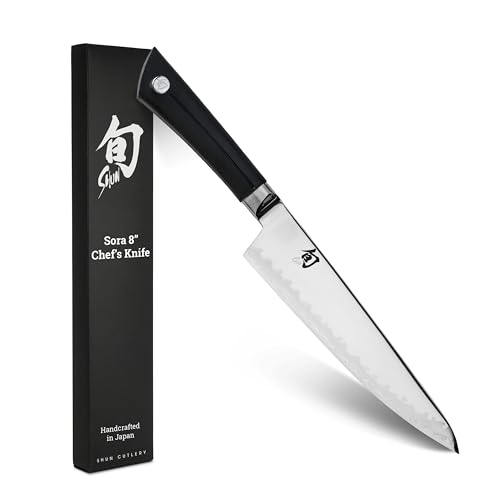
| Shun Sora Chef's Knife | Gyuto style, about 20.3 cm | VG10 San Mai core, 420J upper | not stated | 16 degrees each side | Textured PP/TPE blend |
| Mitsumoto Sakari 22 cm Gyuto | Gyuto, sold as 22 cm; blade about 21.8 cm (spec table) | 3 layer 9CR18MOV high carbon | 58±2 HRC in one place, 60±2 in another | not stated | Octagonal rosewood |
| Shan Zu Damascus Chef Knife | Chef's knife, 20 cm | 67 layer Damascus, core written as 10Cr15CoMoV and 10Cr15MoV | 62 HRC | 15 degrees both sides | Frosted G10 fibreglass (G11 in the title) |
| Kawahiro 220 mm Kiritsuke | Kiritsuke, sold as 220 mm; blade about 21 cm (description) | 3 layer, VG10 core | 62 HRC in the bullets, up to 60 HRC in the description | not stated | Red cinnamon wood and ebony in the bullets; rosewood, turquoise wood and ebony in the description |
| Paudin Nakiri Knife | Nakiri, about 17.8 cm | 5Cr15Mov stainless | 56+ in the bullets, HRC 50+ in the description | not stated | Pakkawood |
Best Japanese knife overall: Hoshanho Chef's Knife
Best Japanese knife overall: the Hoshanho chef's knife, because its listing pairs 10Cr15CoMoV steel at up to 60 HRC with an edge hand sharpened to 13 degrees per side and a sloped bolster for a pinch grip.
The Hoshanho listing describes a matte blade of about 20.3 cm and a wood handle whose sloped bolster, it says, lets you cut without curving your wrist. It names vegetables, fruits, meat and cheese, and comes in a gift box. The spec table gives 350 g. It holds 4.7 stars from 2,685 ratings, the most on this page.
It suits a home chef who wants one everyday knife, or a gift. The honest catch: the listing makes no made in Japan claim, and its hardness of up to 60 HRC sits below the 62 HRC that the Hoshanho santoku and Shan Zu listings state.
Best santoku: Hoshanho Santoku Knife
Best santoku: the Hoshanho santoku knife, because its listing gives it a triple layer 10Cr15CoMoV blade at 62 HRC, a hand sharpened 15 degree edge and a double side groove that it says prevents food sticking.
The Hoshanho santoku listing describes a blade of about 17.8 cm forged from triple layer laminated steel with about 0.9% carbon, an African pakkawood handle and a gift box. It names fruits, bread, vegetables, fillets and meats. The spec table gives 350 g. It holds 4.7 stars from 2,089 ratings.
It suits a home cook who wants a shorter blade than a chef's knife. The honest catch: the listing makes no made in Japan claim, and the blade is shorter than the five chef's knife, gyuto and kiritsuke picks.
Best made in Japan: Shun Sora Chef's Knife
Best made in Japan: the Shun Sora chef's knife, because its listing says it is handcrafted in Japan, with a VG10 San Mai cutting core clad in stainless steel and a hand sharpened 16 degree double bevel edge.
The Shun Sora listing describes a gyuto style chef's knife with a blade of about 20.3 cm. The VG10 core is clad with stainless steel on each side for stain resistance and permanently joined to a 420J blade upper, and the handle is a traditional Japanese design in a textured PP/TPE blend. The spec table gives about 186 g. It holds 4.6 stars from 1,320 ratings.
It suits a professional or home chef, as the title puts it. The honest catch: the listing says hand wash only, the handle is a polymer blend rather than wood, and the listing gives no hardness figure.
Best traditional gyuto: Mitsumoto Sakari 22 cm Gyuto
Best traditional gyuto: the Mitsumoto Sakari 22 cm gyuto, because its listing says it follows the traditional Japanese hand forging method, with three layers of 9CR18MOV high carbon steel and an octagonal wood handle.
The Mitsumoto Sakari listing describes a 22 cm gyuto with an ultra thin 2.5 mm blade and says each knife takes 45 days of hand forging. The spec table gives a rosewood handle and 279 g, and lists a knife cleaning cloth and knife oil; the box is sandalwood. It names fruits, vegetables and meats. It holds 4.5 stars from 2,501 ratings across versions.
It suits a cook who wants a longer gyuto. The honest catch: the spec table says it is not dishwasher safe, its ratings are shared across sizes, and its description gives the hardness as 58±2 HRC in one place and 60±2 in another.
Best Damascus chef's knife: Shan Zu Damascus Chef Knife
Best Damascus chef's knife: the Shan Zu Damascus chef knife, because its listing describes 66 layers of folded steel around a core, 67 layers in all, at 62 HRC, 15 degree edges on both sides and a frosted fibreglass handle.
The Shan Zu listing describes a chef's knife with a 20 cm blade by the spec table and 33 layers of Damascus steel above and below the core, patterned by stacking and repeatedly folding carbon steel sheets rather than by laser etching. It names meat, vegetables and fish, and gives a 24 month warranty. It holds 4.6 stars from 642 ratings.
It suits a cook who wants a layered Damascus pattern on a chef's knife. The honest catch: the spec table says it is not dishwasher safe, the handle is fibreglass, not the wood of most picks here, and the listing is not consistent on the handle (G10 in the bullets, G11 in the title) or on how it writes the core steel.
Best VG10 kiritsuke: Kawahiro 220 mm Kiritsuke
Best VG10 kiritsuke: the Kawahiro 220 mm kiritsuke, because its listing pairs a hand forged three layer blade with a VG10 core, 62 HRC by its bullets, and a handle the bullets describe as red cinnamon wood with ebony and a turquoise inlay.
The Kawahiro listing describes soft steel on both sides of the VG10 core, a hand polished edge and hand forging in what it calls time honoured Japanese techniques. It names slicing delicate vegetables and fish and chopping meat and herbs, and it comes in a wooden gift box. The spec table gives about 190 g. It holds 4.5 stars from 209 ratings.
It suits a cook who wants a VG10 kiritsuke, or a birthday or anniversary gift, as the listing names. The honest catch: it has the fewest ratings here, the spec table says it is not dishwasher safe, its description gives a hardness of up to 60 HRC where its bullets give 62HRC, and the handle woods differ by block: red cinnamon wood, ebony and a turquoise inlay in the bullets, rosewood, turquoise wood and ebony in the description.
Best nakiri: Paudin Nakiri Knife
Best nakiri: the Paudin nakiri knife, because its listing describes a 5Cr15Mov stainless steel blade for slicing, dicing, chopping and mincing that is easy to resharpen, with a pakkawood handle balanced at the pinch point.
The Paudin listing describes a blade of about 17.8 cm, titled a meat cleaver and vegetable kitchen knife, with 56+ hardness in the bullets, HRC 50+ in the description, and a wave pattern it likens to a Damascus knife and says decreases food friction. The soft pakkawood handle is integrated with the blade. The spec table gives 225 g. It holds 4.5 stars from 246 ratings.
It suits a home cook who preps a lot of vegetables. The honest catch: its 56+ hardness (HRC 50+ in the description) sits below the 60 to 62 HRC figures the Hoshanho, Shan Zu and Kawahiro listings state, the listing says the steel is not real Damascus, and it has only 246 ratings.
How to choose a Japanese knife
Knife shape
Gyuto is the name the Shun Sora and Mitsumoto Sakari listings give their chef's knives. The Hoshanho chef's knife and Mitsumoto Sakari name meat, vegetables and fruit, the Paudin nakiri is titled a meat cleaver and vegetable knife, and the Kawahiro kiritsuke names vegetables, fish, meat and herbs. For one knife to do most jobs, the Hoshanho santoku, Kawahiro and Paudin listings say versatile or all purpose.
Blade length
The blades run from about 17.8 cm to 22 cm as sold. The Hoshanho santoku and Paudin are about 17.8 cm, the Hoshanho chef's knife, Shun Sora and Shan Zu about 20 cm, and the Mitsumoto Sakari and Kawahiro are sold as 22 cm and 220 mm, though their listings also give blade lengths of about 21.8 cm and about 21 cm. Our cutting board guide compares boards.
Steel and hardness
No listing here proves one steel beats another. VG10 is on the Shun Sora and Kawahiro, 10Cr15CoMoV on both Hoshanho knives and the Shan Zu, 9CR18MOV on the Mitsumoto Sakari and 5Cr15Mov on the Paudin. HRC is the Rockwell C hardness scale; stated figures run from 56+ on the Paudin (HRC 50+ in its description) to 62 HRC, the Mitsumoto Sakari description gives 58±2 HRC in one place and 60±2 in another, and the Shun Sora gives none.
Edge angle and bevel
None of the seven listings describes a single bevel. The Hoshanho chef's knife is hand sharpened to 13 degrees on each side, the Hoshanho santoku to 15 degrees and the Shun Sora to 16 degrees on each side, and the Shan Zu listing gives 15 degree V shaped edges on both sides. The Paudin listing says it is easy to resharpen; our knife sharpener guide compares stone, electric and guided sharpeners.
Handle material and grip
Five handles are wood or pakkawood: both Hoshanho knives, the Paudin, the Mitsumoto Sakari and the Kawahiro. The Shun Sora uses a textured PP/TPE blend and the Shan Zu frosted fibreglass, G10 in the bullets and G11 in the title. For grip, the Hoshanho chef's knife has a pinch grip bolster, and the Paudin balances handle and blade at the pinch point.
Frequently asked questions
What is the best Japanese knife in Australia?
The Hoshanho chef's knife, a Japanese style knife, is the best Japanese knife for most people. Its listing gives 10Cr15CoMoV steel at up to 60 HRC and an edge hand sharpened to 13 degrees on each side, with 4.7 stars from 2,685 ratings. The Shun Sora is the pick whose listing says handcrafted in Japan.
What is the best Japanese chef knife?
The Hoshanho chef's knife is the top chef's knife pick here and the most rated knife on this page. For the gyuto shape, the Shun Sora is handcrafted in Japan by its listing, with a VG10 San Mai core, and the Mitsumoto Sakari 22 cm gyuto has a three layer 9CR18MOV blade and an octagonal wood handle.
Which Japanese knife brand is best?
Hoshanho is the brand with the most rated knife here, its chef's knife, plus a santoku at the same 4.7 stars. Shun is the brand whose listing says handcrafted in Japan, and the others add a 9CR18MOV gyuto (Mitsumoto Sakari), a VG10 kiritsuke (Kawahiro), a 67 layer Damascus chef's knife (Shan Zu) and a nakiri (Paudin).
Should I get a gyuto or a santoku?
Among these picks the santoku is the shorter knife and the gyuto the longer: the Hoshanho Santoku Knife is about 17.8 cm, the Shun Sora Chef's Knife, titled gyuto style, is about 20.3 cm and the Mitsumoto Sakari gyuto is sold as 22 cm. No listing ranks a gyuto above a santoku.
Which Japanese knife is best for vegetables?
The Paudin nakiri is the vegetable knife here: its title calls it a vegetable kitchen knife, and the listing names slicing, dicing, chopping and mincing. The Hoshanho santoku has a double side groove its listing says prevents food sticking, and the Kawahiro kiritsuke names slicing delicate vegetables.
Are Japanese knives single bevel?
None of the seven knives here is described as single bevel. The Shun Sora listing gives a double bevel at 16 degrees on each side, the Hoshanho chef's knife 13 degrees on each side and the Shan Zu 15 degree edges on both sides. The other four listings do not describe the bevel.
Can Japanese knives go in the dishwasher?
Most of these listings say no. The Shun Sora listing says hand wash only, and the spec tables for the Hoshanho santoku, Mitsumoto Sakari, Shan Zu, Kawahiro and Paudin answer no to dishwasher safe. The Hoshanho chef's knife spec table is the one that answers yes, while its bullets say nothing about washing.
Do Japanese knives rust?
The Hoshanho chef's knife listing claims excellent rust resistance, the Shan Zu corrosion resistance and the Shun Sora stain resistance from its stainless cladding. The Paudin listing calls its steel rust proof, and the Mitsumoto Sakari spec table lists knife oil in the box. These listings describe rust resistance rather than a promise.