The best vocal microphone for most people is the Shure SM58S, because its listing describes a cardioid pickup pattern for maximum gain before feedback and a frequency response shaped for vocals. We compared six handheld microphones on their Amazon Australia listings, spec tables and star ratings: three cardioid dynamic picks from Shure and Behringer, two karaoke mics from TONOR and Singing Machine, and a JBL mic for PartyBox speakers.
Every pick here plugs in by a cable or cord, though the Behringer XM1800S overview row reads wired, wireless and the Shure PGA58 spec table names it a wireless microphone system. Desk mics that plug into a computer are in our USB microphone guide, and wireless systems in our wireless microphone guide. Not stated means the listing gives no detail.
| Microphone | Type and pickup pattern | In the box (listing) | Connection (listing) | On/off switch |
|---|
| Shure SM58S | Dynamic, cardioid | Mic, swivel stand adapter, storage bag; no cable listed | 3 pin XLR | Yes |
| Shure PGA58 | Dynamic, cardioid | Mic, XLR to XLR cable of about 4.6 m, swivel adapter, carrying pouch (maker's section) | XLR | Yes (maker's section) |
| Behringer XM1800S set | Dynamic, cardioid | Three mics, carry case (spec table), stand adapters and mic clips (maker's section); no cable stated | not stated | Yes |
| TONOR K1 | Dynamic, hypercardioid (bullets; super cardioid by the product description) | Mic, XLR cable of about 5 m (title; the product description gives a total length of about 3 m), foam cover, 6.35 to 3.5 mm adapter | XLR to 6.35 mm cable (spec table) | Yes |
| Singing Machine SMM205 | Dynamic, unidirectional | Mic on a cord of about 3.2 m (bullets) or about 3 m (title), adapter (spec table) | 6.35 mm and 3.5 mm jack (spec table) | Mute function (spec table) |
| JBL PBM100 | Dynamic (product description), cardioid | not stated | 3.5 mm jack (spec table); plug n' play with a JBL PartyBox | not stated |
Best vocal microphone overall: Shure SM58S
Best vocal microphone overall: the Shure SM58S, because the listing describes a cardioid pattern for maximum gain before feedback, a frequency response shaped for vocals and a pneumatic shock mount, with an on/off switch built in.
The SM58S is the Shure SM58 cardioid dynamic vocal microphone with an integrated on/off switch, an A25D swivel stand adapter and a storage bag. The listing calls it performance tested and industry standard, with excellent rejection of off axis sound, a brightened midrange and bass roll off to control proximity effect, and a shock mount that minimises mechanical noise and vibration. The title adds a spherical mesh grille with a built in pop filter and a 3 pin XLR connector, and the spec table gives 150 ohms and about 298 g. It holds 4.7 stars from 3,996 ratings on this listing.
It suits a singer who wants one mic shaped for the voice. The honest catch: the listing names no cable, while the Shure PGA58 comes with an XLR to XLR cable.
Best Shure mic with a cable in the box: Shure PGA58
Best Shure mic with a cable in the box: the Shure PGA58, because this cardioid dynamic vocal microphone comes with an XLR to XLR cable of about 4.6 m, and its spec table lists audio mixers and audio interfaces among compatible devices.
The Shure PGA58 bullets describe an updated industrial design with a black metallic finish and grille for unobtrusive visual presence, and name three options: an XLR to XLR cable, an XLR to QTR cable, or no cable. The title and the model number, PGA58 XLR, show this listing is the XLR to XLR version, and the spec table gives a metal enclosure. It holds 4.7 stars from 2,230 ratings.
It suits a singer who plugs into a mixer or audio interface and wants the mic and the lead in one box. The honest catch: the listing gives few sound details beyond the cardioid dynamic design, and it has the fewest ratings on this page.
Best three piece set for vocals and instruments: Behringer XM1800S
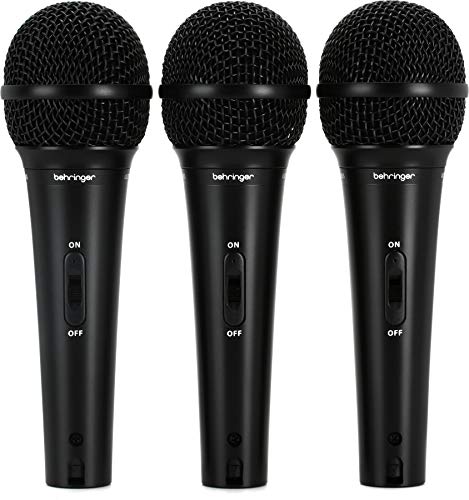
Best three piece set for vocals and instruments: the Behringer XM1800S set, because it puts three cardioid dynamic microphones in one box, each described as a vocal and instrument mic with an on/off switch.
The Behringer XM1800S listing describes an on/off switch to mute during breaks, an ultra wide frequency response for brilliant and transparent sound, an extremely high signal output that lets your voice cut through, and a cardioid characteristic that minimises background noise and feedback. The spec table lists three XM1800S dynamic microphones and a foam lined carry case, a range of 50 Hz to 15 kHz and 600 ohms. It holds 4.6 stars from 3,978 ratings.
It suits a serious musician, a DJ or an all round entertainer, the people its spec table names. The honest catch: the listing does not say a cable comes in the box or name the connector.
Best karaoke mic with an XLR cable: TONOR K1
Best karaoke mic with an XLR cable: the TONOR K1, because the listing gives it a hypercardioid pickup pattern, an on/off switch and an XLR cable of about 5 m by the title (the product description gives a total length of about 3 m) that it says withstands 28.6 kg of pull.
The TONOR K1 listing calls it a dynamic karaoke microphone that captures your voice while minimising background noise and feedback, with low impedance, high sensitivity, all metal construction by the bullets (the spec table gives acrylonitrile butadiene styrene as the enclosure material) and an external switch you push up for on and down for off. The box holds the mic, an XLR cable, a foam mic cover, a 6.35 to 3.5 mm adapter and a manual; the spec table gives 50 to 15,000 Hz and 340 g, while the maker's chart gives the K1 80 Hz to 12 kHz. The product description block differs again: it gives 370 g, a total length of about 3 m and a super cardioid pattern. It holds 4.4 stars from 16,013 ratings across versions.
It suits karaoke singing, speeches and weddings, the uses its title names. The honest catch: its listing gives fewer vocal details than the Shure SM58S, and its rating count is shared with another version.
Best karaoke mic for karaoke machines: Singing Machine SMM205
Best karaoke mic for karaoke machines: the Singing Machine SMM205, because the listing describes a unidirectional dynamic karaoke mic on a cord of about 3.2 m by the bullets (about 3 m by the title), and it has the most ratings on this page.
The Singing Machine SMM205 bullets describe a karaoke microphone with wide frequency response and high sensitivity, a cord long enough to stroll while you sing, and no batteries required, though the spec table lists the power source as battery powered. The spec table lists 6.35 mm and 3.5 mm jack connectors, an adapter, a metal enclosure, 70 Hz to 15 kHz and a 90 day manufacturer warranty, with karaoke machines as the compatible device. It holds 4.4 stars from 25,789 ratings across versions.
It suits karaoke on a karaoke machine, the device its listing names, and our karaoke machine guide compares machines to plug it into. The honest catch: its spec table lists jack connectors rather than XLR and a 90 day warranty, and the listing says to make sure the machine's input jacks work correctly.
Best for JBL PartyBox speakers: JBL PBM100
Best for JBL PartyBox speakers: the JBL PBM100, because the listing says it is plug n' play with the PartyBox for a sing along, with a cardioid pattern and a wire mesh cap with windscreen.
The JBL PBM100 listing describes a vocal microphone with a cardioid pattern that captures vocals and minimises ambient noise, a sleek, rugged, built to last stage quality casing, and a windscreen that suppresses wind blasts and background noise. The spec table gives 50 Hz to 15 kHz, 600 ohms, a plastic enclosure and a 1 year manufacturer warranty. It holds 4.4 stars from 2,457 ratings.
It suits a JBL PartyBox owner who wants to sing along, the use its listing names, and our JBL speaker guide compares JBL models. The honest catch: the listing is built around the PartyBox and does not say what is in the box.
How to choose a vocal microphone
Dynamic, cardioid and hypercardioid
Dynamic is how a mic turns sound into a signal and cardioid is the direction it hears best, so one mic can be both. The Shure PGA58 maker's section says a cardioid pattern picks up audio from the source while rejecting unwanted noise, and the TONOR K1 listing names a hypercardioid pickup pattern. All six listings say dynamic; the JBL PBM100 says so in its product description.
The cable and the connector
Three of the six listings name no cable in the box: the Shure SM58S, the Behringer XM1800S and the JBL PBM100. The Shure PGA58 and TONOR K1 come with an XLR cable, and the Singing Machine SMM205 has its own cord with 6.35 mm and 3.5 mm jacks in its spec table rather than XLR.
Feedback and handling noise
Feedback is the squeal when a mic picks up its own speakers, and handling noise is the thump of a hand moving on the mic. The Shure SM58S listing addresses both, with maximum gain before feedback and a pneumatic shock mount, and the Behringer XM1800S and TONOR K1 listings say their patterns minimise feedback.
What each mic plugs into
The Shure PGA58 and Behringer XM1800S spec tables list mixers and audio interfaces, the TONOR K1 title names karaoke machines, speakers, amps and mixers, the Singing Machine SMM205 lists karaoke machines, and the JBL PBM100 plugs into a PartyBox.
On/off switches and warranty
An on/off switch turns the mic off without unplugging the cable, as the TONOR K1 listing puts it, and the Shure SM58S and Behringer XM1800S listings describe one too. The spec tables give a 2 year limited warranty on both Shure mics, 1 year on the Behringer XM1800S set and the JBL PBM100, and 90 days on the Singing Machine SMM205.
Frequently asked questions
What is the best microphone for singing?
The Shure SM58S is the best microphone for singing for most people on this page: its listing describes a cardioid pattern for maximum gain before feedback, a frequency response shaped for vocals and an integrated on/off switch, with 4.7 stars from 3,996 ratings. For a cable in the box, choose the Shure PGA58.
Which vocal microphone is best for live performance?
For singing into speakers, the Shure SM58S listing describes a uniform cardioid pattern for maximum gain before feedback and an advanced pneumatic shock mount that minimises mechanical noise. The Behringer XM1800S listing says its cardioid characteristic minimises background noise and feedback.
What is the best vocal microphone for recording at home?
Among these mics, the Shure PGA58 and the Behringer XM1800S list audio interfaces among their compatible devices, and the PGA58 comes with an XLR to XLR cable. The Shure SM58S maker's section describes it for sound reinforcement and studio recording, and the Behringer XM1800S maker's section names studio and live performance.
What is the best microphone for karaoke?
For a karaoke machine, the Singing Machine SMM205: its bullets describe a dynamic karaoke mic on a cord of about 3.2 m (about 3 m by the title) with no batteries required, though its spec table says battery powered, and it has the most ratings here. For an XLR cable and an on/off switch choose the TONOR K1.
Should I get a dynamic or condenser microphone for singing?
A dynamic mic is the type the Behringer XM1800S maker's section calls ideal for live applications, saying dynamic mics are robust, resistant to moisture and can achieve high gain before feedback. The Shure SM58S, the TONOR K1 and the Singing Machine SMM205 are listed as dynamic too, and no condenser mic is on this page.
Is a dynamic microphone the same as a cardioid microphone?
No. Dynamic describes how the mic turns sound into a signal, and cardioid describes the direction it picks up best, so one mic can be both. The Shure SM58S is listed as a cardioid dynamic vocal microphone, the TONOR K1 as a dynamic mic with a hypercardioid pattern and the Singing Machine SMM205 as unidirectional and dynamic.
How do you set up a vocal microphone and stand?
The TONOR K1 product description gives the steps: insert the microphone plug in the MIC socket, then take the switch to the on position, and its bullets say the body fits a standard mic stand. The Shure SM58S comes with an A25D swivel stand adapter but no cable, and the Shure PGA58 maker's section names a stand adapter.
Does the Singing Machine microphone need batteries?
The Singing Machine SMM205 blocks disagree: its bullets say no batteries are required, but its spec table lists the power source as battery powered. The mic plugs into a karaoke machine on a cord of about 3.2 m by the bullets, or about 3 m by the title. It holds 4.4 stars from 25,789 ratings across versions.