Why do Australian gutters fill up so fast?
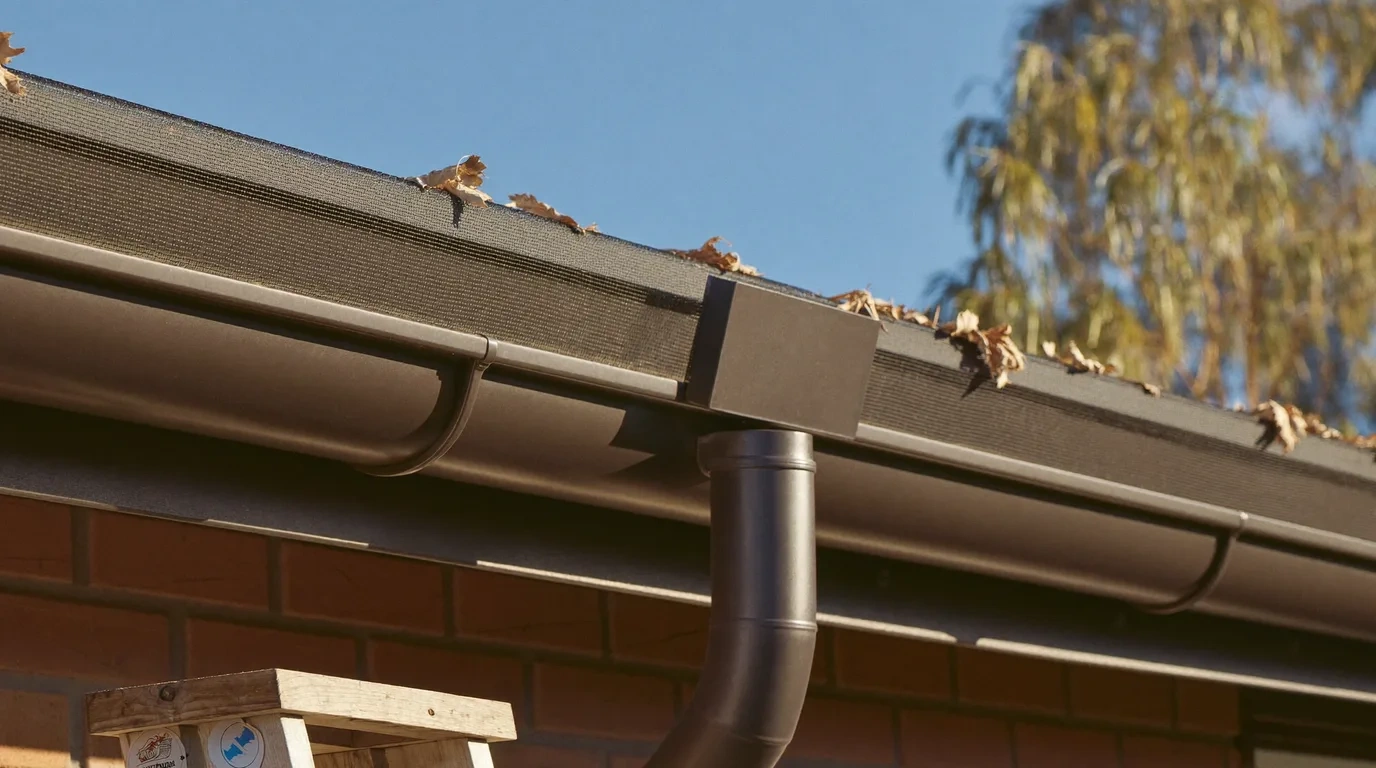
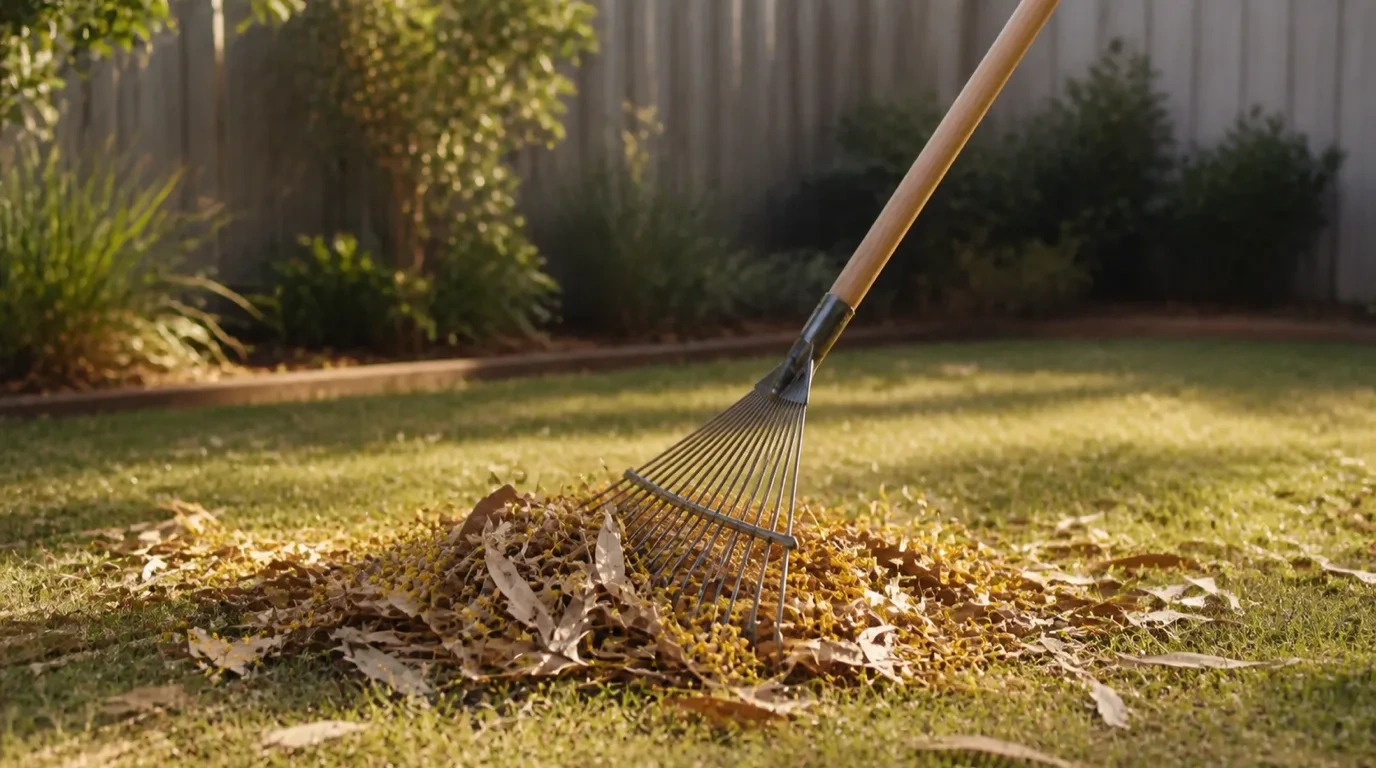
Because most of us live under eucalypts. Gum leaves are narrow, waxy and stiff, they drop all year rather than in one tidy autumn dump, and they mat together into a felt that holds water instead of shedding it. Add stringybark strips, gumnuts and the fine grit that washes off an old tile roof, and a gutter that looked clean in June is a wet sponge by November. That is why American buying guides are close to useless here: they are written around oak leaves and pine needles on shingle roofs, not gum debris on Colorbond.
The second thing that separates the Australian market is the roof itself. A guard that works beautifully on a corrugated profile will not sit down on Trimdek, and neither fits under a concrete tile without a different trim. Almost every disappointed review on Amazon traces back to mesh bought for the wrong roof.
What is the best gutter guard in Australia?
For most Australian homes the best overall DIY gutter guard is the JTOOYS Aluminium Gutter Guard Mesh Roll, a 12.2 metre roll of aluminium mesh with twenty clip hooks. It is mid-price rather than cheap, but it is the one pick here with a real base of feedback: at 876 ratings it is the most-reviewed gutter guard on this page by more than forty times. Aluminium will not rust against a Colorbond gutter, and it cuts to size with scissors.
If your roof is standard corrugated Colorbond and you want a matched fixing system, the GGW 4mm Corrugated Gutter Guard Kit is the runner-up. It bundles 10 metres of powder-coated aluminium mesh with the trims, saddles and screws you need for a corrugated roof, which is where DIY gutter guard usually fails. It holds the highest star rating of our six picks at a full 5.0, but that sits on only three ratings, so treat it as promising rather than proven.
On the tightest budget, the Windyun Gutter Guard Mesh Roll gives you two 20 metre rolls of HDPE poly mesh and sixty clips at the cheapest price per metre here. Poly does not last like aluminium under Australian UV, but nothing on this page covers more metres for less.
Three more picks follow for specific roofs: a Trimdek kit, a tile-roof kit, and a drop-in brush for anyone who cannot or will not screw into their roof.
How do the six gutter guards compare at a glance?
Four things decide whether a guard suits your house: roof profile, mesh material, length per dollar, and whether fixings are included. Tap any name to open the listing.
How we evaluated these gutter guards
NestPath does not install roofing. We research what is actually available to an Australian buyer, then read the listings and the local reviews closely. Four filters did the work.
- Australian availability first: every pick is in stock on Amazon Australia with a real star rating and at least three customer ratings, and reseller-priced outliers were cut.
- Roof profile honesty: a guard only earns a spot if the listing states which roof it fits, because a mismatch is the most common cause of a failed DIY install.
- Material and aperture exactly as listed: aluminium, steel, poly or brush, never a claim we could not find on the listing itself.
- Cost per metre of gutter rather than sticker price, so a cheap short roll does not beat a kit that covers the house.
Best overall: JTOOYS Aluminium Gutter Guard Mesh Roll
This is the pick to start with for most Australian homes, and the reason is evidence. In a category where listing after listing shows three ratings and a stock photo, the JTOOYS roll carries 876 ratings, which makes it the most-reviewed gutter guard on this page by more than forty times. It is not the cheapest and not a full kit: it is a plain 12.2 metre roll of aluminium mesh at 16cm wide with twenty clip hooks, and it cuts with scissors or tin snips.
The 16cm width is narrower than a full-cover system, so it will not bridge from the roof sheet across the gutter and under tiles. It lays into or over a standard quad or half-round gutter, held by the supplied hooks, which suits the runs most people struggle with: a carport, a shed, one problem length under a tree, or the run feeding a rainwater tank. Aluminium will not rust into your Colorbond the way plain steel mesh can, and it holds its shape once bent over the lip. Its 4.3 star average is a tie with the Windyun poly roll below rather than a standout, so buy it for the depth of feedback and the aluminium, not for a chart-topping score.
Flaws but not dealbreakers
No trims and no screws means the install quality is all on you, and hooks alone are less secure than a screwed trim in a high-wind spot. Wear gloves, because cut aluminium edges are sharp and a reviewer calls that out. Check your gutter width against 16cm before ordering, because a wide box gutter will swallow it, and on a full house you will join several rolls end to end.
Best for corrugated Colorbond: GGW 4mm Corrugated Gutter Guard Kit
If your roof is standard corrugated Colorbond, this is the runner-up worth the extra outlay, because it is a kit rather than a roll. You get 10 metres of 250mm wide powder-coated aluminium mesh, plus the gutter trims, the roof saddles and the screws for both. The failure point in DIY gutter guard is almost never the mesh, it is the fixing: mesh cable-tied or siliconed to the gutter lip lifts in the first serious wind, and once one corner lifts the whole run funnels debris underneath.
The mesh aperture is listed as 3mm x 4mm, the sweet spot for Australian debris: fine enough to stop gum leaves, gumnuts and bark strips, open enough that a heavy summer downpour still gets through rather than sheeting over the front. Aluminium will not rust into your Colorbond the way plain steel mesh can, and the powder coat disappears against a Monument or Surfmist fascia. The listing states the kit is made in Australia and describes the mesh as non-combustible with bushfire readiness among its features, which is a description of the material only, not certification. Ten metres is roughly one long side of a single-storey house, so most buyers need three or four kits.
Flaws but not dealbreakers
The number to be honest about is the reviews: it holds the highest star rating of the six picks at a full 5.0, but that rests on only three ratings, so you are buying on specification rather than a deep pile of local feedback. It is also strictly a corrugated-profile kit, so if your roof is Trimdek or tile the saddles will not sit down and you want one of the picks below. And per 10 metres it is far from the cheapest way to cover a big house, just the most likely to still be there in ten years.
Best budget: Windyun Gutter Guard Mesh Roll
Two rolls, twenty metres each, sixty clips, and the lowest price on this page. If your priority is getting something over forty metres of guttering this weekend without a trip to a roofing supplier, this is the answer. The mesh is HDPE plastic rather than metal, the openings are listed at about 10mm square, and it cuts with scissors.
Poly mesh gets a bad rap in Australian roofing circles and some of it is deserved. Under full sun it goes brittle years before aluminium does, and cheap poly sags between fixings until it becomes a debris hammock. But two situations suit it. One is a low-consequence run: a shed, a lean-to, a back verandah where a blocked gutter means a puddle rather than water into the ceiling. The other is a trial, before spending several hundred dollars. Space the clips every 40cm to 50cm and overlap joins by 15cm, because sag is what kills poly installs.
The 10mm opening is coarser than the aluminium kits above, and that is a real trade-off. It stops leaves, twigs and the bulk of what a gum drops, but fine bark strips and seed capsules find their way through. If your problem is a big paperbark or a she-oak, expect to still flush the gutter occasionally.
Flaws but not dealbreakers
UV life is the honest weak point, and no plastic mesh is a twenty-year product on an Australian roof. The rating sits at 4.3 stars on a small number of reviews, tied with the JTOOYS roll rather than ahead of it. And because there is no trim, this is a gutter-lip solution rather than a roof-to-gutter bridge, so it will not stop debris that blows in under the first row of tiles.
Best for a Trimdek roof: Ergo Panel Systems Trimdek Kit
Trimdek and the other flat-pan deck profiles are where generic gutter guard falls over. The ribs are widely spaced and square rather than rounded, so a corrugated saddle bridges the pan instead of clamping it and the mesh sits proud with a gap underneath. This kit is made for that profile: 10 metres of aluminium mesh with Colorbond steel gutter trims, Trimdek saddles, screws and instructions.
The listing states a mesh aperture of 3mm x 4mm, describes the aluminium as non-combustible, and quotes a 15 year warranty on the mesh. It is made in Australia. That combination of a matched saddle plus a real warranty is what you are paying the premium for, and it is the priciest of our six picks.
Installation is a two-person job. The mesh runs from the gutter trim up onto the roof sheet, where saddles screw into the crest of the rib and clamp the mesh edge. Get the tension right and it forms a shallow ramp that sheds leaves down the roof line. Get it wrong and you have a shelf.
One honest note from a local reviewer: the Trimdek capping is less visually neat than the same brand's corrugated version, because a square rib gives the trim less to hug. Match your trim colour to the gutter or fascia rather than the roof sheet, since the trim is what you see from the driveway.
Flaws but not dealbreakers
Seven ratings is a small sample, and the highest price here buys specification rather than crowd validation. The capping fit on the Trimdek profile is the one recurring criticism. And like every screwed system, it puts fasteners into your roof, so if you are renting or your roof is near end of life, look at the brush option instead.
Best for a tile roof: Ergo Panel Systems Tile Roof Kit
Tile roofs need wider mesh than metal roofs, because the guard slides up under the first course of tiles rather than screwing to a rib. This kit runs 500mm wide over 10 metres with Colorbond steel gutter trims and self-drilling screws, and it is the only pick here designed for that job.
The method is straightforward once you have seen it. You lift the bottom row of tiles slightly, slide the top edge of the mesh underneath so it sits on the sarking or the batten, then fix the lower edge into the gutter trim. The tile weight holds the top, the trim holds the bottom, and the mesh spans the gap where leaves currently drop straight in. Reviewers describe it as easy with complete screws supplied, and one suggests watching a short video on the tile-lift step first.
Aperture is the same 3mm x 4mm aluminium as the metal-roof kits, and the mesh is described as non-combustible. On a tile roof the guard does a second job people forget: it blocks the gaps birds and possums use to reach the roof cavity through the eaves line. If you have had scratching above the ceiling in spring, a full-width tile guard often fixes it as a side effect. Older terracotta is brittle, so have a few spare tiles on hand before you start.
Flaws but not dealbreakers
This is the lowest-rated pick on the page at 3.8 stars from four ratings, and the critical feedback is about fit fussiness rather than materials. The install is also the most physical of the six, since you are working under tiles from a ladder. And 500mm of mesh over 10 metres is bulky to handle in wind, so pick a still morning.
Best no-drill option: Gardeon Gutter Guard Brush 16M
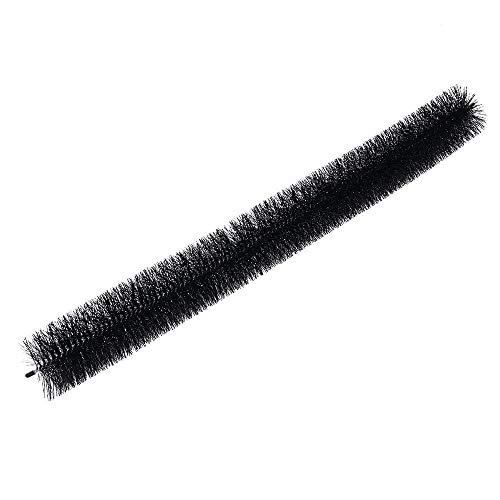
Brush guard is the one option here that puts nothing into your roof. It is a 10cm diameter cylindrical brush, nylon bristles on a galvanised steel wire core, that you drop into the gutter. Eighteen 92cm pieces give you 16 metres. Cut or bend them to length, push them in, done. No screws, no trims, no chalk line.
That makes it the obvious answer for renters, for anyone whose roof is due for replacement soon, and for people who should not be doing a screwed install from a ladder. It is also the second-highest rated pick here at 4.9 stars, and the Australian reviews are unusually specific: buyers report it stopping birds and possums nesting under the roof line, and one notes water now flows cleanly into their rainwater tank.
The bristles hold debris above the water channel while rain passes through the middle. Because they sit inside the gutter rather than across the top, they do not stop debris arriving. They stop it settling into a wet mat at the bottom where it rots and blocks the outlet. Your gutter stays draining, but it does not stay clean. The listing gives the country of origin as Australia.
Flaws but not dealbreakers
The honest criticism, straight from a three-star Australian reviewer, is that the bristles catch and hold leaves, so you need to lift them out and shake them off more often than you would clean under a flat mesh. That reviewer still rates them as doing the job for low initial effort. Sixteen metres also does not go far on a full house, so budget for two or three sets. And on a very leafy site, brush is a reduction in cleaning rather than an end to it.
What should you look for in a gutter guard?
Start with your roof, not the product. Everything else follows from it.
Roof profile. Corrugated, deck profiles like Trimdek, and tile all need different fixings. Corrugated saddles clamp a rounded rib, deck saddles clamp a square one, and tile systems have no saddle at all: they tuck under the first course. Buying the wrong one is the most common mistake in this category.
Material. Aluminium is the default for a permanent install: no rust, holds shape, non-combustible as a material. Stainless micro-mesh is finer and better against pine needles but blinds off faster with roof grit. Poly is cheap with a shorter life under Australian UV. Brush is the no-drill compromise. Do not mix bare steel mesh with a Colorbond gutter, because dissimilar metals in contact corrode.
Mesh aperture. Around 3mm to 4mm is the practical range for gum debris. Much finer and you fight grit blinding on an old roof. Much coarser, as with 10mm poly, and bark strips and seed capsules get through. Read the listed aperture rather than trusting the word fine.
Cost per metre, not sticker price. Measure your gutter run first. A single-storey rectangular house is often 40 to 50 metres all up, which is four or five 10 metre kits. Divide the kit price by its metres and compare that. A cheap short roll can work out dearer per metre than a kit. And a roll with clips is a different product from a kit with trims, saddles and screws: if the listing does not say screws are included, assume they are not.
Bushfire claims. Some listings describe their aluminium as non-combustible or mention ember protection. Treat that as a description of the material, not certification. Australian bushfire requirements come from your BAL assessment and are enforced through your council, and a compliant ember guard install is work for a certified installer.
One more practical point: whatever you buy, you will be on a ladder. Set it on firm level ground, tie it off or have someone foot it, and never lean out past your belt buckle. If your ladder is a wobbly relic from the last owner, replace it first: our step ladder guide covers the sturdier options. Two storeys is a job for a professional.
How do you keep a gutter guard working?
A guard turns gutter maintenance from a wet, unpleasant job into a dry, quick one. It does not delete it, and anyone telling you otherwise is selling something.
Twice a year, look. Late autumn and again before storm season. You are checking three things: debris sitting on the mesh, mesh that has lifted at a join or corner, and a downpipe outlet holding water.
Clear the top surface. On a mesh system leaves are supposed to dry out and blow off. In a sheltered valley or behind a chimney they will not. A soft brush on a telescopic pole handles most of it from the ground, and a leaf blower along the roof line is faster: our leaf blower guide covers models with enough airflow to be useful up there.
Lift and shake brush guards. Debris catches in the bristles rather than blowing off, so once or twice a year you pull the sections out, shake them, and drop them back. That is the whole routine.
Watch the valleys. Roof valleys concentrate everything, and even with guard fitted a valley can pack with leaves and push water back under the tiles. Downpipe outlets deserve a strainer of their own.
After a big storm, walk around from the ground. Look for a section of mesh that has lifted or a trim that has popped: catching one loose corner early stops a whole run funnelling debris underneath. At the two year mark, run a driver along the fixings, because thermal movement backs screws out on a west-facing roof.
You'll also want
Six things that make the install and the upkeep easier. One of them is not optional.
- Gobabo Roof Gutter Cleaning Scoop, about $32. Clear the gutter before you cover it, otherwise you are sealing a compost heap under new mesh. The hooked shape pulls debris from under gutter brackets.
- Telescopic gutter cleaning brush, about $63. Reaches the roof line from the ground so your twice-yearly top-surface clean does not need the ladder at all.
- SEIWEI 304 stainless downpipe filter, about $25. Sits in the downpipe outlet and catches whatever gets past the guard. Comes in 50mm, 75mm, 110mm and 160mm, so measure your outlet first.
- Aluminium valley splash guards, 2 pack, about $35. Foldable diverters for the corners where a valley dumps straight over the front of the gutter in heavy rain.
- HYAVIA aluminium gutter guard mesh roll, about $22. Spare mesh for the awkward corner you underestimated and the shed you were not planning to do.
- YUET pressure washer wand extension, about $40. Turns an existing pressure washer into a ground-level gutter and roof rinse. Use it gently on poly mesh.
Gloves are the non-negotiable one. Cut aluminium edges are sharp and old gutters hold everything from broken glass to rusted screw heads. A decent pair from our work gloves guide costs less than a tetanus booster.
The competition
Plenty of gutter guard is sold here. This is what we looked at and left off.
LBG Products stainless micro-mesh gutter cover. Thirty-five epoxy-coated stainless panels with screws and a hex driver. Good specification and the finest mesh in the pool, but the Australian listing carries no customer rating at all, and it is sized around 4 inch and 5 inch American gutter profiles rather than Australian quad.
Raptor and A-M Gutter Guard sample packs. Both are well known American micro-mesh systems, and both appear on Amazon Australia mainly as sample packs. A sample is not a product you can install.
Downpipe wedges and strainers sold as gutter guard. The Wedge, expandable aluminium downpipe strainers, stainless drain covers. Useful accessories, and two are in our list above, but they protect one outlet each. They are not a gutter guard.
Installed systems: Leaf Guard Australia, Gumleaf, Aussie Gutter Protection. These names dominate the search results, and for good reason. A professionally installed steel or aluminium system with matched trims, fitted by someone insured to be on your roof, is a better long-term outcome than anything in this guide. It is also typically several thousand dollars for a whole house rather than a few hundred, and it is not sold through Amazon. If you have a two-storey house, a complex roof, a bushfire-rated requirement, or no appetite for ladder work, get installer quotes instead.
Bunnings and Stratco off-the-shelf mesh. Stratco gutter guard mesh and similar hardware-store rolls are serviceable and often cheaper per metre. We list Amazon products because we can verify stock, price and rating live, not because the hardware aisle is worse.
Gutter guard questions Australian homeowners ask
Do gutter guards actually stop you cleaning your gutters?
No, and any product that promises it is overselling. A good guard changes the job rather than removing it. Instead of scooping wet, rotting sludge out of a gutter from a ladder, you are brushing dry leaves off the top of a mesh, often from the ground with a pole. Expect to check the roof line twice a year, clear the sheltered spots where debris will not blow off, and keep an eye on valleys and downpipe outlets.
What mesh size do you need for gum leaves?
An aperture of around 3mm to 4mm is the practical range for Australian gum debris. That is fine enough to stop gum leaves, gumnuts, bark strips and small twigs, while staying open enough that a heavy summer downpour passes through instead of sheeting over the front of the gutter. Finer stainless micro-mesh handles pine needles better but blinds off faster with the grit that washes off an older tile roof.
How much gutter guard do you need for an average Australian house?
Measure before you order, but a single-storey rectangular house is commonly 40 to 50 metres of gutter all up, which is four or five 10 metre kits. Walk the perimeter with a tape or pace it out, add the garage and any lean-to you actually care about, then add about ten percent for overlaps at joins and corners.
Can you fit gutter guard to a tile roof yourself?
Yes, if the roof is single-storey and the tiles are sound. A tile kit uses wider mesh, typically around 500mm, that slides up under the first course of tiles and fixes into a trim along the gutter. You lift the bottom row of tiles slightly, tuck the mesh underneath so the tile weight holds it, then screw the lower edge into the gutter trim. Older terracotta tiles can be brittle, so have a few spares on hand before you start.
Are DIY gutter guards bushfire rated?
Treat every bushfire claim on a product listing as a description of the material rather than certification. Several aluminium meshes are listed as non-combustible and some mention ember protection or bushfire readiness, which tells you what the metal is, not what your house needs. Australian bushfire construction requirements come from your BAL assessment and are enforced through your local council, and a compliant ember guard install is work for a certified installer.
Bundle it with the rest of the outdoor jobs
Gutter guard is one line on the seasonal maintenance list. These cover the rest of the outside of the house. For smaller pruning jobs around the garden, compare secateurs.
About the author
Anish Puri founded NestPath in 2026 after going through the Australian first-home-buyer process himself. NestPath focuses on Australian first-home buyers because the existing review sites are American, generic, or both. Anish handles editorial selection across the homeowner hub. Reach out: hello@nestpath.com.au