Every Australian backyard eventually needs a cricket set, and almost every one of them gets bought badly. You go looking for a bat, a ball and three stumps, and land in a category where the same phrase covers a $35 plastic toy for a three year old and a $900 senior kit with pads and a helmet. The pages that rank for this search are retailer collection listings sorted by price. They do not tell you that a size 3 bat is wrong for your seven year old, that the stumps in most cheap sets will not stand up on lawn, or that the ball matters more than the bat.
This guide covers backyard and beach sets: the ones a family actually plays with on grass, sand or a driveway, from toddler wooden sets through to a full size plastic kit for teenagers. It is not a guide to club gear. Everything below is listed on Amazon Australia, and every price, star rating and review count was pulled live while writing.
What is the best cricket set for an Australian backyard?
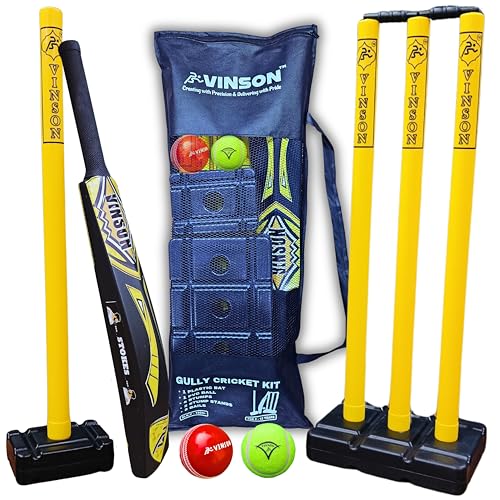
For most families with primary school kids, the Vinson Junior Cricket Kit is the set to buy. It is the only one here that gives you two wicket stands, so you can set up both ends properly instead of bowling at one lonely stump and arguing about whether it was out. It comes with a PVC windball rather than a tennis ball, which is the right call for grass, and it packs into a carry bag. It sits at 4.3 stars from 143 ratings, and the Australian reviews are specific in a way that fake ones are not.
If the players are under six, the Bluey Wooden Cricket 10-Piece Playset is a better match: real wood, a short bat and a bowling marker, at a price that does not sting when it gets left out in the rain.
Both are classic Christmas presents in this country, which is why the category peaks in December. If you are already building that list, our guide to Christmas decorations in Australia covers the other half of the trip.
How do these five cricket sets compare?
Prices are the Amazon Australia listing prices at the time of writing and they move in the run up to Christmas. Ratings and review counts are parent-level figures.
| Set | From | Rating | Best for |
|---|
| Vinson Junior Cricket Kit | $65.99 | 4.3 (143) | Most backyards, ages 8 to 12 |
| Bluey Wooden Cricket 10-Piece | $43.50 | 4.3 (52) | Toddlers and preschoolers |
| Nerf Foam Cricket Set | $72.96 | 4.3 (85) | Indoors and mixed ages |
| Summit Senior Cricket Set | $69.00 | 4.0 (3) | Teenagers and adults |
| GRS Kids Zone Willow Set | Under $75 | 3.8 (1,751) | The willow bat option |
How did we choose these cricket sets?
NestPath does not run a cricket net. We are an aggregator, and the honest version is this: we read the full listing for every set in the Amazon Australia cricket category, pulled the live price, star rating and review count for each one, then checked the specifications against the sizing standards the sport already uses.
Four filters did the work. The set had to be in stock in Australia with a real star rating and at least three ratings behind it, which removed a long tail of new generic listings carrying a single five star review. The price had to make sense for the category, so anything at more than double comparable sets was treated as a reseller artefact and dropped. The set had to actually be a set: a bat, a ball and a wicket. And we read the Australian reviews specifically, because a set that works fine on a UK lawn behaves differently on dry summer buffalo grass.
Where a listing contradicted itself, we went with the specification fields and the photographs rather than the marketing copy. Several sets here describe a moulded plastic bat as willow somewhere in their attributes, and we flag those below rather than repeat them.
Which cricket set suits most Australian backyards?
The Vinson Junior Cricket Kit is the pick for the widest range of families, and the reason is the wickets. Nearly every set at this price gives you one wicket stand. Vinson gives you two, so you can set both ends up the way the game is actually played. That single difference turns a set from a bat and ball into a game the kids can run themselves.
The kit is built for the 8 to 12 age bracket, which the listing calls tweenager sizing. The bat is a 450 gram double blade design, light enough for a nine year old to swing through the line but with enough mass that a decent shot goes somewhere. The stumps set weighs 750 grams, which matters more than it sounds: heavier bases stay upright on grass instead of tipping over every time someone runs past. The ball is a PVC windball rather than a tennis ball, so it swings a little and does not skid off the surface the way a tennis ball does, and it will not travel far enough to clear a suburban fence.
Everything packs into an included carry bag. The kit weighs 2.1 kilograms and measures 75 by 27 by 12 centimetres boxed, so it fits in a car boot for the beach or the park. Australian reviewers are consistent on durability: one grandparent bought it for a ninth birthday and reported it had not stopped being used.
Flaws but not dealbreakers
Packaging is the recurring complaint. Several reviewers received the kit in soft cardboard that arrived crushed, contents fine but the box not presentable as a gift, so plan to rewrap it. The bat is also genuinely sized for 8 to 12 year olds, so a six year old will find it long.
Which cricket set works for toddlers and preschoolers?
The Bluey Wooden Cricket 10-Piece Activity Toy Playset is the one to buy for kids who are three to five and mostly interested in hitting something. It is a real wooden set, not a foam novelty, and it sits at the cheap end of the five picks here.
Ten pieces means a bat, a ball, a wicket stand made up of three stumps, one base and two bails, a bowling marker and a mesh carry bag with a rope handle. The bowling marker is a small thing that matters a lot with little kids, because it gives them somewhere to stand and stops the run up debate before it starts. The bat is 60.7 centimetres long and the set weighs 800 grams, so a three year old can carry it themselves without help.
The wood is certified by the Forest Stewardship Council, and the set is rated for ages 3 and over with a small parts warning below that. In a country where Bluey is effectively the national children's brand, the licensing is not a gimmick, it is the reason a four year old picks the bat up instead of asking for the iPad. Australian reviewers describe it as a good little set for family play.
Flaws but not dealbreakers
The stumps do not sit tightly in the base. This is the single most common complaint in the Australian reviews, and it is real: several owners report the stumps wobble, lean and will not hold the bails on grass. On a hard flat surface it works. If you want proper stumps, budget for a separate set and treat this as a bat and ball purchase with a wicket thrown in.
Which cricket set can you use indoors?
The Nerf Foam Cricket Set is the answer to hallway cricket, wet January afternoons and any household where the batting order spans a four year old and a forty year old. Everything that flies is foam, so the risk calculus changes completely.
The bat is 76 centimetres of foam with a comfort grip handle, closer to a senior length than any other junior set here, and it comes with two foam balls, three plastic wickets and two bails. Two balls is genuinely useful, because the first thing that happens with any cricket set is the ball goes over the fence. Made by Franklin Sports under the Nerf licence, the set weighs 771 grams.
The reason this earns a place is age range. A foam bat that long is comfortable for an adult to hold and safe for a child to be hit by, so the whole family plays the same game with the same equipment. Every other set here forces you to choose an age bracket. This one does not, and it is the set that gets used in a rental courtyard or a long hallway.
The trade-off is that foam does not behave like cricket. The ball does not carry, it does not bounce off a hard surface predictably, and a foam bat teaches a slightly odd swing. As a first exposure to the game it is excellent. As preparation for club cricket it is not.
Flaws but not dealbreakers
At $72.96 it is priced like a serious set for what is essentially a foam toy. The plastic wickets are basic and share the stability problems of every lightweight stump on grass. Foam also degrades in Australian sun faster than plastic, so bring it inside.
Which cricket set suits teenagers and adults?
The Summit Senior Cricket Set is the only pick here built for full grown players. At $69.00 it gives you a senior sized plastic bat, stumps, bails, a one-dayer ball and a carry bag, and it is the set to buy when the kids have outgrown junior gear and the adults have started taking the backyard game seriously.
Summit is an Australian sporting brand, and this set has been listed since 2019, which in a category full of six month old generic listings counts for something. The packaged set measures 78 by 10 by 5 centimetres and weighs 1.55 kilograms, so the bat is a genuine senior length rather than a stretched junior. The listing describes it as suited to backyard play, beach games and school PE sessions, and the carry bag makes it practical to throw in a car for a park game.
The one-dayer ball is the detail worth noting. It is a plastic match style ball rather than a tennis ball, so it swings, comes off the bat properly and will hurt if it hits a small child. Buy this for the older bracket and keep a windball in the bag for when the little ones join in.
The listing carries only 3 ratings, the fewest of any pick here, sitting at 4.0. That is thin. It earns its place because it is the only credible senior backyard set in the Australian catalogue at this price.
Flaws but not dealbreakers
Three ratings is genuinely limited evidence and you should weigh it accordingly. The listing also contradicts itself, describing durable wooden construction in the bullet points while the title and material field both say plastic. Treat it as a plastic set. Colours are not selectable, so you get what arrives.
Which cricket set gets you a real willow bat?
The GRS Kids Zone set is the willow option in this guide: a size 3 Kashmir willow bat, a wicket set of three stumps, two bails and a base, and a tennis ball. It is one of the most reviewed picks in this guide, with 1,751 ratings behind it, and at 3.8 stars it is the lowest rated. Both of those facts matter.
The specification is legitimate. A size 3 bat at 72 centimetres and 1,250 grams with a rubber grip and wooden handle, a wicket set of three stumps, two bails and a base, and one tennis ball. Size 3 is the standard fit for a player of roughly 137 to 144 centimetres, which the listing translates as 6 to 10 years old, a wider band than the table above. For a child who wants a bat that sounds right when it connects, this is the honest route to willow on this list.
The reason it sits last is quality control. At 3.8 stars across 1,751 ratings the distribution matters more than the average, and the Australian reviews include a scathing one star complaint about build quality and a six week delivery. Kashmir willow at this price is soft, unpressed willow: it dents, it can crack on a hard ball, and it is not the material sold at cricket specialists for ten times the money. Buy it as a genuine willow bat priced so a broken bat in one season is annoying rather than painful, not as club standard equipment.
Flaws but not dealbreakers
Quality is inconsistent across units, which is what 3.8 stars from that many ratings actually means. The tennis ball is the wrong ball for a willow bat on grass. Some Australian orders have shipped slowly from overseas warehouses, so check the delivery estimate before you count on it for a birthday.
What should you look for in a cricket set?
Bat size is the decision that matters most and the one almost everybody gets wrong. Cricket bats are sized by player height, not age, and a bat that is too long forces a child to lift the handle away from their body and swing across the line. Junior sizing is standard across brands, and Amazon Australia listings use it: the Gunn and Moore Rival 606 listing, for instance, states that a size 3 suits players of 137 to 144 centimetres.
| Bat size | Player height | Rough age |
|---|
| Size 1 | 122 to 129 cm | 4 to 5 |
| Size 2 | 129 to 137 cm | 6 to 7 |
| Size 3 | 137 to 144 cm | 8 to 9 |
| Size 4 | 144 to 150 cm | 9 to 10 |
| Size 5 | 150 to 157 cm | 10 to 11 |
| Size 6 | 157 to 163 cm | 11 to 13 |
| Harrow | 163 to 168 cm | 12 to 14 |
| Short handle | 168 cm and over | 15 and over |
The ball is the second decision and it changes the game more than the bat does. A tennis ball skids and does not swing, which is why backyard games with one turn into slogging. A PVC windball, like the one in the Vinson kit, has seams, swings a little and does not carry far, which is the best all round choice for a suburban yard. An all-weather rubber ball is safest for under eights. A plastic match ball like the Summit one-dayer behaves closest to real cricket and is the one to keep away from small children.
Stumps are where sets fail. The lightweight three stump and base arrangement in most kits will not stand on lawn, and this is the single most common complaint across the category. Look for heavier bases and note the weight if the listing gives it: the Vinson stumps set weighs 750 grams, which is why it stays up. A separate stump set with a rubber base fixes a flimsy one for good.
Then check what the set contains. Two wicket stands is a meaningfully better game than one, a carry bag means the set survives the year, and a bowling marker stops arguments. Check handedness too: most moulded bats are ambidextrous, but not all, and a left handed child with a right handed grip is a bad first experience.
How do you look after a backyard cricket set?
Plastic and moulded sets need almost nothing, with one exception. Australian ultraviolet exposure makes plastic brittle over a summer, and a set left on the lawn from October to March will crack rather than fade. Keep it in the shade or in the carry bag it came with. Foam degrades faster still, so the Nerf set should live indoors.
Willow needs actual maintenance. A new Kashmir willow bat should be knocked in before it faces a hard ball, which means tapping the face and edges with a mallet or an old ball for a few hours across a week or two to compress the fibres. Skipping this is why cheap willow bats crack on the first decent shot. Keep willow dry, never leave it in a hot car, and re-oil the face lightly with raw linseed oil once a season.
Sand is the beach set's enemy. Rinse plastic gear in fresh water after a beach session, because salt residue works into the moulded seams and stumps that have been in salt water stop sliding into their bases cleanly.
Finally, count the bails. They are the first thing to disappear and the reason half the cricket sets in Australia are unusable by February.
What else do you need for backyard cricket?
A set gets you playing. These keep it playable, and fix the specific weaknesses in the sets above.
- SKYHI wind cricket balls, pack of six, from $28.99. Six soft practice windballs solves the two problems every set has: the ball that came with it is misshapen, and the ball goes over the fence. Rated 4.0 from 19 ratings.
- Kookaburra plastic stumps with heavy rubber base, from $64.90. The permanent fix for wobbly stumps: a solid rubber base holds three stumps upright on grass, turf or a hard floor.
- TSA plastic cricket stump set. A cheaper stump upgrade if the Kookaburra set is more than you want to spend.
- Kookaburra standard weight bails, set of four. Two spare pairs, because bails vanish. Cheap insurance for a set you keep using.
- DSC Ring Chevron rubber bat grip, from $11.10. For a willow bat whose grip has gone hard and slippery. Rated 4.3 from 770 ratings.
- Cricket bat grip applicator cone, from $20.99. You cannot get a new grip onto a bat without one, and it lasts forever.
- MARIB string cricket ball. A leather ball on a string for solo practice against a tree or a clothesline, which is how most Australian kids got good. Rated 4.2 from 18 ratings.
What did not make the cut?
The Hy-Pro officially licensed The Hundred cricket set is well made and rates 4.5 from 37 ratings, with a size 3 plastic bat, foldable stumps that double as a target and a tennis ball. It costs more than every pick in this guide, and the branding is an English competition that means little to an Australian child.
The Protoner wooden cricket set at $80.00 has 228 ratings and sits at 3.5 stars, and the reviews explain why. Alongside owners who found it good value, there is a report of the bat breaking on the first shot. At that price the GRS set gives you the same idea for less money with better odds.
The DSC and SS Kashmir willow bundles that dominate Amazon Australia search results are club kits, not backyard sets. They include batting pads, gloves, a thigh guard, an abdominal guard, an arm guard and a kit bag. If your child has been picked for a junior club side, that is the right shopping list. It is not this one.
Department store and hardware sets are worth naming too. Big W, Kmart, Target, rebel and Bunnings all stock plastic sets, often cheaper than anything here, and for a single beach afternoon they are fine. The trade-off is that stock varies by store and you cannot check a star rating before you drive there.
Cricket set questions Australian families ask
What size cricket bat does my child need?
Size the bat by height, not age. A child of 122 to 129 centimetres needs a size 1, 129 to 137 centimetres a size 2, 137 to 144 centimetres a size 3, and so on up to short handle above 168 centimetres. Gunn and Moore state on their Amazon Australia listing that a size 3 suits players of 137 to 144 centimetres. A bat that is too long is worse than one slightly too short, because the child compensates by lifting the handle and swinging across the ball.
Is a plastic or wooden cricket set better for the backyard?
Plastic for most families, wood if the child is serious. Moulded plastic sets need almost no maintenance, though Australian sun makes plastic brittle over time, so store them out of direct sun between games. A willow bat like the one in the GRS set sounds and feels like real cricket, but it needs knocking in, it needs to stay dry, and cheap Kashmir willow dents and cracks. Wood is a step up in experience and a step down in durability.
How much should you spend on a backyard cricket set in Australia?
Under $80 covers everything a backyard needs, and price inside that band is buying brand and inclusions rather than quality. Above $100 you are usually into club kit territory with pads and helmets, which is a different purchase.
Can you use a backyard cricket set at the beach?
Yes, and plastic sets are better at it than wooden ones. Sand works into moulded seams but rinses out with fresh water, whereas salt and sand ruin a willow face. Rinse and dry everything before it goes back in the bag.
What are the backyard cricket rules most Australian families play by?
Six and out is the universal one: hit it over the fence and you are out and you fetch it. One hand one bounce lets a fielder catch you out with one hand after a single bounce, which keeps small children involved. Tip and run forces the batter to run on any contact. Automatic wicketkeeper applies when you are short of players. These are house rules, not laws of cricket, and settling them before the first ball prevents most backyard arguments.
What else belongs in the backyard?
A cricket set is usually the first piece of outdoor kit a new home buys, and rarely the last. These guides cover the rest of the backyard.
Also in the backyard-play set: slip and slides, cubby houses and kids bikes.
About the author
Anish Puri founded NestPath in 2026 after going through the Australian first-home-buyer process himself. NestPath focuses on Australian first-home buyers because the existing review sites are American, generic, or both. Anish handles editorial selection across the homeowner hub. Reach out: hello@nestpath.com.au