The best bike computer for most people is the COOSPO BC26, because its listing describes a GPS unit that shows speed, distance, ride time and altitude, syncs rides to Strava through the CoospoRide app and lists 25 hours of battery in GPS mode. This page compares five bike computers and speedometers using only what each Amazon listing and its spec table state, plus the star rating and rating count shown for each.
Four of the five are GPS units: the COOSPO BC26, the Wahoo ELEMNT BOLT v3, the iGPSPORT BiNavi and the COOSPO CS500. The fifth, the CATEYE Velo Wireless+, is a speedometer and odometer whose listing names no GPS. Where a listing mentions radar, it describes pairing a radar or a radar light, and no radar comes in any box list. This page covers computers only; for locking the bike, our best bike locks guide covers locks.
| Bike computer | Screen size (listing) | Battery life (listing) | Weight (listing) | Mount named in the listing |
|---|
| COOSPO BC26 | About 5.8 cm | 25 hours in GPS mode | 50 g | Mount adapter base |
| Wahoo ELEMNT BOLT v3 | Listing blocks differ | 15 hours | 84 g | Out front mount and stem mount, zip ties |
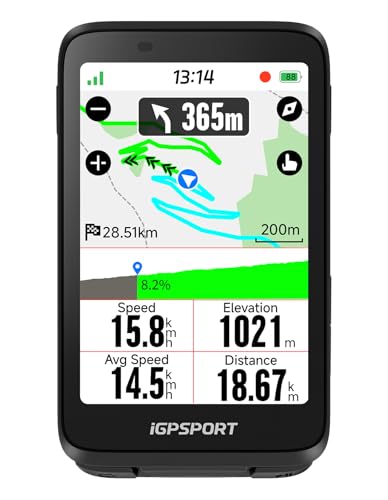
| iGPSPORT BiNavi | About 8.9 cm | 30 hours (title); 35 hours (bullets, description, spec table) | 103 g | None named in the contents lists |
| COOSPO CS500 | About 6.6 cm | 45 hours (title, bullets); 50 hours (overview table, spec table) | not stated | Mount base |
| CATEYE Velo Wireless+ | not stated | not stated | About 32 g | Zip tie mount for stem or handlebars (bullets) |
Best bike computer overall: COOSPO BC26
Best bike computer overall: the COOSPO BC26, because the GPS unit shows speed, distance, ride time and altitude on an auto backlit screen of about 5.8 cm, syncs rides to Strava through the CoospoRide app and lists 25 hours of battery in GPS mode.
The listing describes dual GPS positioning that tracks the riding map and uploads to Strava, and it displays current, max and average speed, total and trip distance, cycling time and altitude. The screen is a segment code FSTN glass display of about 5.8 cm that the listing calls sunlight readable. The CoospoRide app sets the unit up, loads a GPS track route map and syncs the .fit activity file to Strava over Bluetooth. Battery life is 25 hours in GPS mode. It weighs 50 g and measures 7.2 cm long by 2.2 cm high. The box list names a charger cable, a user manual and a mount adapter base, with no wall adapter and no speed or cadence sensor. The title says wireless speedometer, but the spec table lists a GPS sensor, so the speed it shows is GPS speed. It holds 4.4 stars from 430 ratings.
It suits riders who want the uses its listing names: long riding adventures and sharing rides with friends on Strava, and the description calls it an entry level GPS cycling computer for beginner cyclists. The honest catch: the screen is a segment code display, the listing names no turn prompts, no speed or cadence sensor comes in the box, and the rating rests on 430 ratings.
Best on device turn by turn navigation: Wahoo ELEMNT BOLT v3
Best on device turn by turn navigation: the Wahoo ELEMNT BOLT v3, because its listing describes on device turn by turn prompts for GPX and TCX files and routes from Strava, Ride With GPS and Komoot, with LED and audible cues and ANT+ rearview radar integration.
The BC26 listing describes speed, distance and Strava sync and names no turn prompts; this listing's first bullet is on device turn by turn navigation. The listing says top LEDs and audible cues show the next turn or an off course moment, and that saved routes download and completed rides upload automatically when synced with compatible accounts. Take Me To builds a route from a location picked on the map page or in the ELEMNT Companion App. Smart notifications appear only when riding with a smartphone. An ANT+ rearview radar can be paired to show vehicles approaching from behind, and no radar is in the box list. The overview table and the description give different screen sizes, so none is given here. Battery life is 15 hours in the description and spec table, with USB-C charging mid ride. The description lists Bluetooth Smart, ANT+ and WiFi where the spec table lists Bluetooth. It weighs 84 g, measures 47 by 24 by 83 millimetres and the spec table gives IPX7. The box list names a USB-C charging cable, an integrated out front mount, a stem mount and zip ties, with no wall adapter and no sensor, although the spec table lists heart rate, cadence and speed sensor types. It holds 4.4 stars from 232 ratings.
It suits riders who follow routes from Strava, Ride With GPS or Komoot, ride with a smartphone for notifications, or pair an ANT+ rear radar, which are the uses its listing names. The honest catch: the listing gives 15 hours of battery, fewer hours than the figures given for the other GPS units here, no speed or cadence sensor is named in the box, and the rating rests on 232 ratings.
Best touch screen map navigation: iGPSPORT BiNavi
Best touch screen map navigation: the iGPSPORT BiNavi, because its transflective touch screen of about 8.9 cm shows a multi colour route view with automatic rerouting, and iClimb Pro detects climbs and shows gradient profiles as you ride.
The listing describes a transflective display of about 8.9 cm that it calls readable in direct sunlight, with touchscreen and button control, a 1.45 cm body, IPX7 and 1.5 hour fast charging. Named navigation features are terrain sensing and predictive navigation, a real time multi colour route view with automatic rerouting, and one tap navigation to destinations set in the app. iClimb Pro auto detects climbs and shows gradient profiles in real time. The listing also names dual band GNSS, motion detection, music control, action camera integration, and connections to speed, cadence and heart rate sensors, power meters and iGPSPORT radar tail lights. The title says 30 hours of battery life; the bullets, description and spec table say 35. It weighs 103 g. The contents lists name a charging cable, a lanyard, two screen films and a user manual (the spec table adds a protective case) and no mount, although the spec table gives the mounting type as handlebar. It holds 4.5 stars from 113 ratings.
It suits the uses its listing names: long rides in any weather, commuting or short rides under 100 km with one tap navigation, hill planning and group riding. The listing also names action camera integration, and our action camera guide compares the cameras. The honest catch: the listing gives two battery figures, 30 hours in the title and 35 hours elsewhere, no mount is named in the contents lists, and the rating rests on 113 ratings.
Best for 140+ cycling metrics: COOSPO CS500
Best for 140+ cycling metrics: the COOSPO CS500, because its listing says it shows more than 140 cycling metrics on customisable screens, adds preloaded maps with turn prompts on an auto backlit screen of about 6.6 cm, and works with a radar light.
The listing names GPS, BeiDou, GLONASS, GALILEO and QZSS positioning, an LCD graphical grid display of about 6.6 cm with an auto backlight, preloaded maps and turn prompts, and customisable screens for more than 140 cycling metrics. It works with a radar light and with BLE and ANT+ sensors such as speed, cadence and heart rate sensors, trainers and power meters. The CooSporide app shares data to Strava and Training Peaks, and the bullets say IPX7. The title and bullets give a 45 hour battery life; the overview table and spec table give 50 hours. The box list names a mount base, an anti rope, a charge cable and a user manual, with no wall adapter and no sensor, and the spec table gives stem mount and handlebar mount as mounting types. The listing states no weight. It holds 4.4 stars from 122 ratings.
It suits the uses its listing names: riding in night or low light conditions with the auto backlight, route guidance without external devices, and riders who have a radar light. The honest catch: no radar comes in the box, the listing gives 45 hours in the title and bullets and 50 hours in the overview and spec tables, and the rating rests on 122 ratings.
Best speedometer with a programmable odometer: CATEYE Velo Wireless+
Best speedometer with a programmable odometer: the CATEYE Velo Wireless+, because its listing says it shows current, max and average speed, trip and total distance, elapsed time and calories on a backlit display, and the odometer can be set by hand after a battery change.
The title calls it a wireless cyclocomputer with speedometer and odometer, calorie tracking, auto start and stop, a programmable odometer and a backlight display. The bullets add a pace arrow and a clock, and say the odometer can be set manually so the total does not start over when the battery changes. The listing says an included zip tie mount fits the stem or handlebars, and the description says it installs on almost any bike, including 27.5 and 29er bikes. It measures 5.6 by 3.8 by 1.9 cm and weighs about 32 g. The included components row names a battery and no charging cable. The listing states no screen size and no battery life. It holds 4.4 stars from 140 ratings.
It suits the uses its listing names: riding after the sun sets, thanks to the backlight, and mounting on the stem or handlebars. The honest catch: the listing names no GPS, maps or app, it does not say how long the battery lasts, and the rating rests on 140 ratings.
How to choose a bike computer
GPS unit or speedometer
Four of the five listings describe GPS units, and the CATEYE Velo Wireless+ describes a speedometer and odometer with no GPS named. The COOSPO BC26 listing says its GPS tracks the riding map and uploads to Strava, while the CATEYE listing names no maps or app.
Turn by turn navigation and route maps
The Wahoo ELEMNT BOLT v3 is the listing built around turn by turn navigation. The COOSPO CS500 names preloaded maps and turn prompts, and the iGPSPORT BiNavi names a multi colour route view with automatic rerouting. The COOSPO BC26 lists loading a GPS track route map in its app and names no turn prompts.
Battery life as each listing states it
The listings give hours from 15 to 50, and two of them give two figures: the iGPSPORT BiNavi 30 in the title and 35 elsewhere, the COOSPO CS500 45 in the title and bullets and 50 in the overview and spec tables. The Wahoo ELEMNT BOLT v3 lists 15 hours, the COOSPO BC26 25 hours in GPS mode, and the CATEYE none.
Sensors, radar, charging and mounts
None of the five included components rows names a speed or cadence sensor or a radar. The four GPS units each name a cable and no wall adapter, and the CATEYE Velo Wireless+ names a battery. Radar pairing or radar accessories appear in the Wahoo, COOSPO CS500 and iGPSPORT listings. The iGPSPORT BiNavi contents lists name no mount.
What the ratings and counts show
The ratings run from 4.4 to 4.5 stars, and every count is small: 113 for the iGPSPORT BiNavi, 122 for the COOSPO CS500, 140 for the CATEYE Velo Wireless+, 232 for the Wahoo ELEMNT BOLT v3 and 430 for the COOSPO BC26. Each rating rests on a few hundred ratings at most.
Frequently asked questions
What is the best bike GPS?
The COOSPO BC26 is the top pick GPS unit here: its listing describes speed, distance, ride time and altitude on a screen of about 5.8 cm, with 25 hours of battery in GPS mode. The Wahoo ELEMNT BOLT v3 is the pick for on device turn by turn navigation, and the iGPSPORT BiNavi for a touch screen map.
What is the best bike computer for beginners?
The COOSPO BC26: its description calls it an entry level GPS cycling computer for beginner cyclists, and its bullets name speed, distance, ride time, altitude and Strava sync through the CoospoRide app. The listing names no turn prompts. The CATEYE Velo Wireless+ is a speedometer and odometer whose listing names no GPS, maps or app.
What does a bike computer show?
The CATEYE Velo Wireless+ listing names current, max and average speed, trip and total distance, elapsed time and calories. The COOSPO BC26 names speed, distance, cycling time and altitude, and the COOSPO CS500 names more than 140 cycling metrics on customisable screens. Maps and route guidance appear only in the GPS unit listings.
Which bike computer has turn by turn navigation?
The Wahoo ELEMNT BOLT v3: its listing opens with on device turn by turn navigation, with LED and audible cues. The COOSPO CS500 listing names preloaded maps and turn prompts, and the iGPSPORT BiNavi names a multi colour route view with automatic rerouting. The COOSPO BC26 and CATEYE Velo Wireless+ listings name no turn prompts.
How long does a bike computer battery last?
The listings give 15 hours for the Wahoo ELEMNT BOLT v3 and 25 hours in GPS mode for the COOSPO BC26. The iGPSPORT BiNavi gives 30 hours in the title and 35 in the bullets and spec table; the COOSPO CS500 gives 45 in the title and bullets and 50 in the overview and spec tables. The CATEYE states none.
Do these bike computers work with Strava?
The COOSPO BC26 listing says it uploads rides to Strava and syncs .fit files through the CoospoRide app. The Wahoo ELEMNT BOLT v3 lists routes from Strava and automatic ride uploads to linked accounts, the COOSPO CS500 lists sharing data to Strava and Training Peaks, and the iGPSPORT BiNavi lists road books from apps such as Strava and Komoot.
Do these bike computers work with a radar light?
Three listings name radar: the Wahoo ELEMNT BOLT v3 lists pairing an ANT+ rearview radar, the COOSPO CS500 says it works with a radar light, and the iGPSPORT BiNavi lists radar tail lights among its accessories. No radar comes in any box list. The COOSPO BC26 and CATEYE Velo Wireless+ listings name none.
What is in the box, and how do these bike computers charge?
The four GPS units name a cable and no wall adapter: a charger cable for the COOSPO BC26, a USB-C charging cable for the Wahoo ELEMNT BOLT v3, a charging cable for the iGPSPORT BiNavi and a charge cable for the COOSPO CS500. The CATEYE Velo Wireless+ lists a battery. No speed or cadence sensor appears in any box list.