The best graphics card for most people is the XFX Swift Radeon RX 9060 XT OC 16GB, because its listing pairs AMD's RX 9060 XT chip with 16GB of GDDR6 memory and a 3 year limited maker warranty. We compared six desktop graphics cards from XFX, Gigabyte, MSI and Intel on what each listing and its spec table state: the chip, the memory, the size figures and any power advice, plus each card's star rating.
All six spec tables list Desktop as the compatible device, and laptops and renewed cards are not on this page. This page covers the card that goes inside a desktop PC, while our mini PC guide compares small complete computers. Performance appears here only as the listings' own feature names, such as DLSS 4 and XeSS.
The six cards side by side; not stated means no figure.
| Card and chip | Memory | Fans | Size the listing gives | Power advice in the listing |
|---|
| XFX Swift AMD Radeon RX 9060 XT OC | 16GB GDDR6 | 3 | Spec table: 29 by 12.4 cm | not stated |
| Gigabyte NVIDIA GeForce RTX 5060 Windforce OC | 8GB GDDR7, 128 bit | not stated | Spec table: 19.9 by 11.6 cm | not stated |
| MSI NVIDIA GeForce RTX 5060 Ti Shadow 2X OC | 16GB GDDR7; one spec table row says GDDR6 | 2 | Bullets: 2 slot card, 226 mm long | 600 W or more, 8 pin |
| Gigabyte NVIDIA GeForce RTX 5070 Ti Windforce OC SFF | 16GB GDDR7, 256 bit | 3 | Spec table: 30.4 by 12.6 cm | not stated |
| Gigabyte AMD Radeon RX 7600 Gaming OC | 8GB GDDR6, 128 bit | 3 | Spec table: 28.2 by 11.5 cm | not stated |
| Intel Arc B580 Limited Edition | 12GB GDDR6 | not stated | not stated | not stated |
Best graphics card overall: XFX Swift Radeon RX 9060 XT OC 16GB
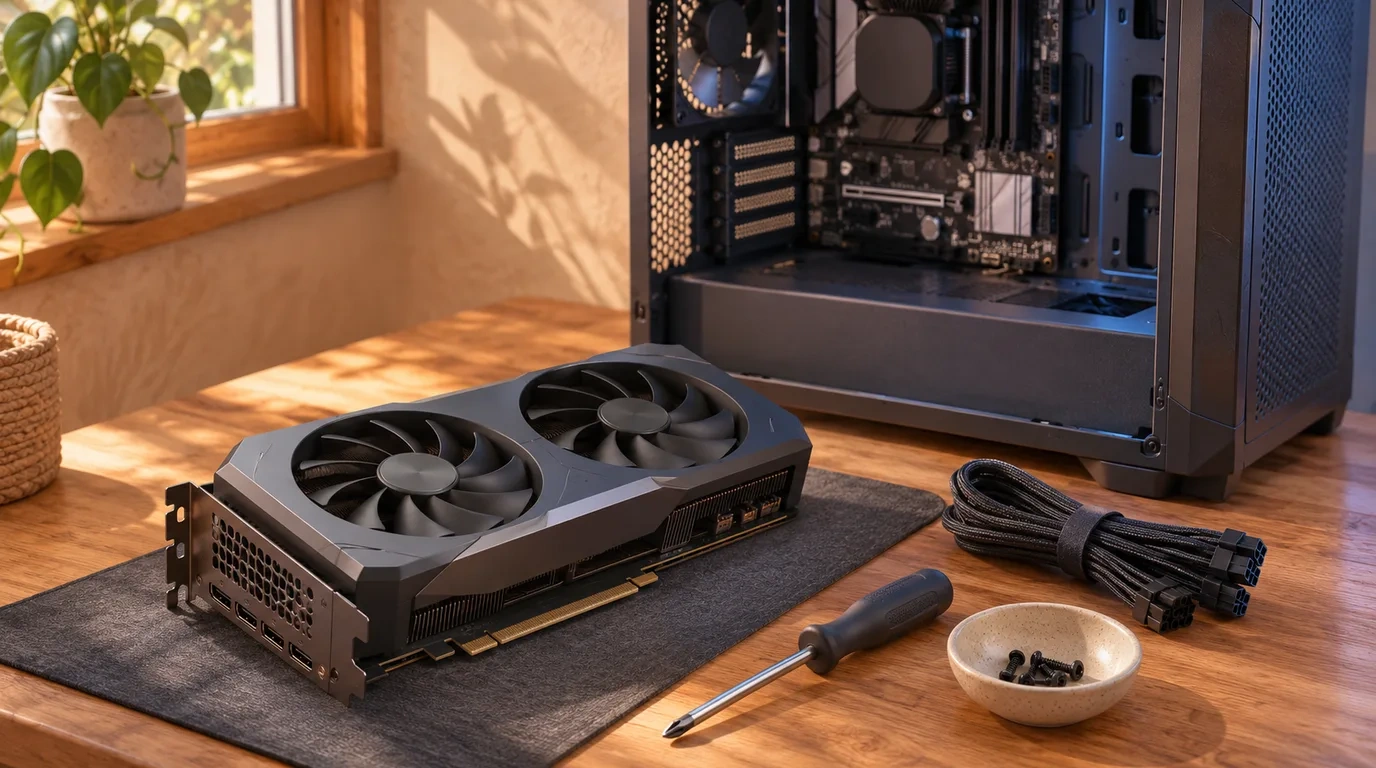
Best graphics card overall: the XFX Swift Radeon RX 9060 XT OC 16GB, because it pairs AMD's RX 9060 XT chip with 16GB of GDDR6 memory, a triple fan cooler and a boost clock up to 3320 MHz, with a 3 year limited maker warranty listed.
The XFX spec table describes 16GB GDDR6 memory at 20 GHz, counts 3 fans on the SWFT white triple fan cooler and lists a PCI Express x16 interface with DisplayPort and HDMI outputs. The XFX Swift RX 9060 XT OC holds 4.8 stars from 457 ratings across the white and black versions.
It suits a desktop PC, the compatible device its spec table names, and its title calls it a Gaming Edition. The honest catch: the spec table gives 29 by 12.4 cm without saying whether that is the card or the box, and the listing does not state power needs.
Best 8GB NVIDIA card: Gigabyte GeForce RTX 5060 Windforce OC 8G
Best 8GB NVIDIA card: the Gigabyte GeForce RTX 5060 Windforce OC 8G, because the listing gives 8GB of 128 bit GDDR7 memory, PCIe 5.0 and the NVIDIA Blackwell architecture with DLSS 4, and it has the most ratings on this page.
The Gigabyte spec table adds a GPU clock speed of 2512 MHz and a memory clock speed of 28000 MHz, and gives 19.9 by 11.6 cm in its dimensions row. The Gigabyte RTX 5060 Windforce OC 8G holds 4.7 stars from 845 ratings.
It suits games and creative applications, the two uses its product description names. The honest catch: it has 8GB of memory, half the 16GB of the top pick, and the listing does not state power needs.
Best 2 slot card: MSI GeForce RTX 5060 Ti 16G Shadow 2X OC
Best 2 slot card: the MSI GeForce RTX 5060 Ti 16G Shadow 2X OC, because its bullets give a 2 slot card 226 mm long with 16GB of memory and two STORMFORCE fans, and a recommended power of 600 W or more with an 8 pin connector.
The MSI bullets add the Blackwell architecture with 4th generation RTX ray tracing, DLSS 4.0 support, a ZERO FROZR fan mode of 0 RPM, PCIe 5.0 x8, a weight of 578 g and rear ports of 3 DisplayPort 2.1b and 1 HDMI 2.1b. The spec table gives a 2602 MHz GPU clock speed and a 2 year manufacturer guarantee. The MSI RTX 5060 Ti 16G Shadow 2X OC holds 4.7 stars from 340 ratings.
It suits a desktop case with room for a 2 slot card 226 mm long, the size its bullets give. The honest catch: the spec table's graphics description row says 16GB GDDR6 memory, while the title, the bullets and the spec table's memory type row say GDDR7.
Best RTX 5070 Ti card: Gigabyte GeForce RTX 5070 Ti Windforce OC SFF
Best RTX 5070 Ti card: the Gigabyte GeForce RTX 5070 Ti Windforce OC SFF, because it brings 16GB of GDDR7 on a 256 bit memory interface, a 2497 MHz boost clock and a dual BIOS system for efficiency or quiet running, and the listing marks it NVIDIA SFF Ready.
The Gigabyte title adds 28Gbps memory, PCIe 5.0, DisplayPort 2.1b and HDMI 2.1b, and the spec table counts 3 fans on the Windforce cooling system and lists a memory clock speed of 28000 MHz. The Gigabyte RTX 5070 Ti Windforce OC SFF holds 4.8 stars from 347 ratings.
It suits a desktop build that wants the efficiency and quiet BIOS modes its listing names. The honest catch: the spec table gives 30.4 by 12.6 cm without saying whether that is the card or the box, and the listing does not state power needs.
Best 8GB AMD card: Gigabyte Radeon RX 7600 Gaming OC 8G
Best 8GB AMD card: the Gigabyte Radeon RX 7600 Gaming OC 8G, because it has a triple Windforce fan cooler, a metal backplate, 8GB of 128 bit GDDR6 and one HDMI 2.1 plus two DisplayPort 2.1 outputs.
The Gigabyte listing adds PCI Express 4.0 support and RGB Fusion, and the spec table lists a memory clock speed of 18000 MHz and gives 28.2 by 11.5 cm in its dimensions row. The Gigabyte RX 7600 Gaming OC 8G holds 4.6 stars from 685 ratings, the second most here.
It suits a desktop that needs one HDMI 2.1 and two DisplayPort 2.1 outputs, as the listing gives them. The honest catch: it is a PCI Express 4.0 card with 8GB of memory, where the three NVIDIA picks list PCIe 5.0, and the listing does not state power needs.
Best Intel card: Intel Arc B580 Limited Edition
Best Intel card: the Intel Arc B580 Limited Edition, because it has 12GB of graphics memory and hardware AV1 encode and decode, with XeSS Frame Generation listed.
The Intel listing describes second generation Xe cores with an XMX AI engine and media engines with hardware encode and decode for HEVC (H.265), AVC (H.264) and VP9 as well as AV1, and the spec table gives GDDR6 memory with DisplayPort and HDMI outputs. The Intel Arc B580 Limited Edition holds 4.7 stars from 92 ratings.
It suits gaming apps and AI engines that use graphics memory, the uses its listing names for the 12GB. The honest catch: it has 92 ratings, the fewest here, and the listing gives no size figure and does not state power needs.
How to choose a graphics card
Memory size and type
Every listing here states its graphics memory. The Gigabyte RTX 5060 and Gigabyte RX 7600 list 8GB, the Intel Arc B580 lists 12GB, and the XFX RX 9060 XT, MSI RTX 5060 Ti and Gigabyte RTX 5070 Ti list 16GB. The three NVIDIA cards list GDDR7, though one row of the MSI spec table says GDDR6, and the other three list GDDR6. Where a listing gives the memory bus, it is 128 bit on the Gigabyte RTX 5060 and RX 7600, 192 bit in the MSI title and 256 bit on the Gigabyte RTX 5070 Ti.
NVIDIA, AMD or Intel
Three of the six listings name DLSS 4 or XeSS Frame Generation. The Gigabyte RTX 5060 and MSI RTX 5060 Ti name the NVIDIA Blackwell architecture and DLSS 4, the Intel Arc B580 names XeSS Frame Generation, the Gigabyte RTX 5070 Ti listing is marked NVIDIA SFF Ready, and the two AMD listings name the chip, memory and cooler.
Card size and case room
Only the MSI RTX 5060 Ti listing states a card length: a 2 slot card 226 mm long. The XFX and Gigabyte spec tables give a length by width row without saying whether it is the card or the box, from 19.9 by 11.6 cm on the RTX 5060 to 30.4 by 12.6 cm on the RTX 5070 Ti.
Power and connectors
A graphics card is powered inside the PC from the computer's own power supply. Only the MSI RTX 5060 Ti listing gives power advice: a recommended power of 600 W or more, with 8 pin and 180W in the same bullet. The other five listings do not state power needs.
Outputs, video and AI features
Every listing here names DisplayPort and HDMI outputs: the MSI RTX 5060 Ti lists 3 DisplayPort 2.1b and 1 HDMI 2.1b, and the Gigabyte RX 7600 lists 1 HDMI 2.1 and 2 DisplayPort 2.1. For video and AI, the Intel Arc B580 lists hardware AV1 encode and decode and an XMX AI engine, and the Gigabyte RTX 5060 description names Tensor Cores and AI acceleration. Our monitor guide compares screens for those outputs.
Frequently asked questions
What is the best graphics card in Australia?
On this page it is the XFX Swift Radeon RX 9060 XT OC 16GB, with AMD's RX 9060 XT chip, 16GB of GDDR6 memory and a triple fan cooler. The Gigabyte RTX 5060 Windforce OC 8G has the most ratings here, and the Gigabyte RTX 5070 Ti lists 16GB of GDDR7.
What graphics card should I get?
On listing facts and ratings, the XFX Swift RX 9060 XT OC 16GB is our overall pick: its title calls it a Gaming Edition, with 16GB of GDDR6 memory. The Gigabyte RTX 5060 and MSI RTX 5060 Ti listings name DLSS 4 and the NVIDIA Blackwell architecture, and this page compares listing facts and ratings only.
What is the best AMD GPU?
Of the two AMD cards here, the XFX Swift Radeon RX 9060 XT OC 16GB is our overall pick, with 16GB of GDDR6 and a boost clock up to 3320 MHz. The Gigabyte Radeon RX 7600 Gaming OC 8G lists 8GB of 128 bit GDDR6 and PCI Express 4.0.
Which graphics cards support DLSS 5?
None of the six listings here names DLSS 5. The Gigabyte RTX 5060 Windforce OC 8G lists DLSS 4 with the NVIDIA Blackwell architecture, and the MSI RTX 5060 Ti 16G Shadow 2X OC lists DLSS 4.0 support. The Intel Arc B580 listing names XeSS Frame Generation.
Is a graphics card the same as a GPU?
Shoppers use the two words for the same product, but strictly the GPU is the chip and the graphics card is the board that carries it with memory, fans and outputs. The MSI listing shows the split: the RTX 5060 Ti GPU on a card with 16GB of memory and two fans.
Do graphics card fans always spin?
Not on every card: the MSI RTX 5060 Ti 16G Shadow 2X OC listing describes a ZERO FROZR mode of 0 RPM for its two STORMFORCE fans. The other five listings describe no fan stop mode, and the Gigabyte RTX 5070 Ti lists efficiency and quiet BIOS modes.
Do graphics cards come with cables?
None of the six listings names a cable in the box. The Built In Media rows of the spec tables list the card plus a quick install guide for the XFX RX 9060 XT, and the card plus a manual for the Gigabyte RTX 5060 and Gigabyte RX 7600.
How long do graphics cards last?
No listing here gives a lifespan, but two spec tables state a maker warranty: 3 years limited on the XFX Swift RX 9060 XT OC and a 2 year manufacturer guarantee on the MSI RTX 5060 Ti 16G Shadow 2X OC. The other four spec tables give no warranty figure.