What is the best kids play kitchen in Australia right now?
For most Australian homes, the best kids play kitchen is the Teamson Kids Little Chef Florence at $99.99. It is the highest-reviewed wooden play kitchen of the seven we compared, holding a 4.5-star average from more than 2,000 owners, and it pairs a genuinely compact footprint with the realistic touches toddlers actually use: clicking stove knobs, a turning gooseneck faucet and pull-out storage bins. If you want the same wooden build in a slightly smaller cabinet, the Teamson Boston is the value pick. And if you are in a flat or shopping for a younger toddler, the CUTE STONE Play Sink gives you running water and a stove for well under $55.
A play kitchen is one of the few toys that earns its shelf space. Pretend cooking builds language, fine motor skills and social play, and a good wooden one will outlast three or four kids. The catch is that the listings on Amazon Australia swing wildly in quality, and the photos rarely warn you about the two things that matter most: how long assembly takes, and how big the thing actually is once it is built. We dug into real owner ratings, dimensions, materials and accessory counts to sort the keepers from the flat-pack regrets.
The quick answer: our top play kitchens at a glance
Here is the short version if you are buying tonight. Every pick below was confirmed in stock on Amazon Australia, with a real star rating and review count pulled in June 2026. Prices move, so treat them as a guide rather than a promise.
- Best overall: Teamson Kids Little Chef Florence, 4.5 stars from 2,109 owners, around $100. The most reviewed wooden cabinet here and the best all-rounder.
- Best value: Teamson Kids Little Chef Boston, 4.2 stars from 408 owners, around $110. Same wooden build, smaller farmhouse footprint.
- Best budget: CUTE STONE Play Sink, 4.3 stars from 5,165 owners, around $45. The cheapest and most reviewed pick, with running water.
- Most accessories: HONEY JOY 18-piece wooden kitchen, 4.2 stars, around $93. One box that fills a play corner.
- Best for drawing and lists: Bopeep wooden kitchen, 4.4 stars, with a chalkboard fridge.
- Best for the backyard: OLAKIDS mud kitchen, 4.5 stars, fir wood on wheels with a real water box. If the kitchen is going outside anyway, a cubby house with a built-in kitchen covers both jobs.
- Biggest statement piece: Teamson Westchester retro pink, 4.3 stars from 426 owners, around $180.
Last verified 6 September 2026. We refresh this guide as stock, pricing and ratings change on Amazon Australia.
How do these play kitchens compare side by side?
The fastest way to narrow the field is to weigh three things against each other: the owner rating, the material and the footprint. Wooden cabinets look better in a living room and last longer, but they are heavier and take real effort to assemble. Plastic tabletop sets are cheaper, lighter and often have lights, sounds and water, but they wear out faster. The comparison table below lays out where each pick lands so you can match it to your space and budget before you read the full write-ups.
One honest theme runs through almost every wooden listing in this category, and it is worth saying upfront: owners love the finished product but warn repeatedly about assembly. Build times of two to three hours come up again and again, and a cordless drill is mentioned so often it is practically a required accessory. None of that is a dealbreaker, but it is the single most common surprise, so plan for an evening rather than a quick job before a birthday.
| Play kitchen | Best for | Material | Standout feature | Amazon AU rating |
|---|
| Teamson Kids Little Chef Florence | Overall | Wood | Clicking stove knobs, turning gooseneck faucet, pull-out bins | 4.5 from 2,109 |
| Teamson Kids Little Chef Boston | Value | Wood | Same wooden build in a smaller farmhouse cabinet | 4.2 from 408 |
| CUTE STONE Play Sink | Budget and small flats | Plastic | Running water from a real tap, plus a stove | 4.3 from 5,165 |
| HONEY JOY 18-piece wooden kitchen | Most accessories | Wood | 18 pieces in the one box | 4.2 |
| Bopeep wooden play kitchen | Drawing and menus | Wood | Chalkboard fridge door | 4.4 |
| OLAKIDS outdoor mud kitchen | The backyard | Fir wood | On wheels with a real water box | 4.5 |
| Teamson Westchester retro kitchen | Statement piece | Wood | Full-size retro cabinet | 4.3 from 426 |
How did we choose these play kitchens?
We are an aggregator, not a toy lab. We do not bring kitchens home and put them through a wringer. Instead we study what hundreds of Australian owners already report, then cross-check the specs against the live Amazon Australia listings so the numbers in this guide match what you will actually see at checkout. Here is what shaped the shortlist:
- Real owner ratings on Amazon Australia. Every pick has a genuine star rating and at least three reviews. We dropped listings with no verified feedback, no matter how good the photos looked.
- In-stock and buyable. We confirmed each model was available to ship in Australia in June 2026. Several popular brands quoted elsewhere, such as IKEA DUKTIG and Plum, do not sell through Amazon Australia, so they sit outside our scope and we say so plainly below.
- Material and durability signals. We favoured solid engineered wood and pine over thin plastic where the budget allowed, and we read the critical reviews closely for repeated complaints about flimsy panels or parts that stop working.
- Footprint and age fit. We logged the built dimensions and the manufacturer age range so you can tell a nursery-corner cabinet from a floor-hogging statement piece, and a toddler set from one aimed at older preschoolers.
- Accessory value. Some sets arrive with 18 pieces, others with a phone and a pan. We weighed what is in the box against the price so you know whether you will be buying add-ons.
Best play kitchen overall: Teamson Kids Little Chef Florence
If you want one play kitchen that looks good in your home, holds up to daily use and keeps a toddler busy for years, the Teamson Little Chef Florence is the one to buy. It is the highest-reviewed wooden play kitchen of our seven picks, sitting at 4.5 stars from 2,109 owners, and that volume of consistent feedback is the strongest signal of a safe buy in this category.
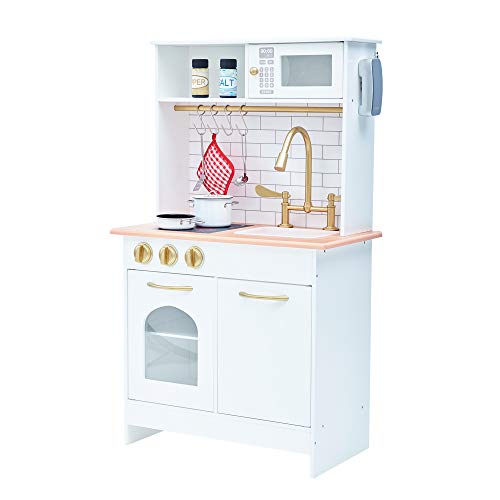
The Florence is a full wooden cabinet in white with mint and yellow accents, and it packs in an oven, a fridge, a sink, a microwave, a clock and pull-out colour-coded storage bins. The stove knobs click and turn, the gooseneck faucet handle moves, and the oven door opens with a pull-down hinge, which is exactly the kind of moving-part realism that turns a static box into hours of pretend cooking. At 54.6 by 29.5 by 90.2 cm it has a slim footprint, so it tucks into a play corner without taking over the room, and the 90 cm height suits a child from around three years up.
Owners repeatedly call it sturdy and well made once built, and several note it stays in good condition after a year of heavy daily play across siblings. The accessories are modest, a small set of cookware and utensils, but the cabinet itself is the value here. Reviewers who compared it to a plastic kitchen consistently say they are glad they spent a little more on wood.
Flaws but not dealbreakers
The recurring caveat is assembly. There are a lot of pieces, and even owners who are confident with flat-pack furniture report it taking around an hour or more, with several switching to an electric screwdriver to speed things up. The instructions are well regarded and clearly numbered, so it is fiddly rather than confusing. The other note is that it photographs larger than it is, so check the dimensions if you pictured a big kitchen. For the price and rating, neither is a reason to skip it.
Best value play kitchen: Teamson Kids Little Chef Boston
The Teamson Boston is the pick when you want the wooden look and the clicking-knob realism of our top choice in a tighter footprint and at a similar price. It carries a 4.2-star rating from 408 owners and is listed as Amazon's Choice in the Australian toy kitchen category, which reflects steady demand and reliable shipping.
Styled as a compact farmhouse cabinet, the Boston has white cabinetry, gold-tone handles and a faux subway-tile splashback, which is why it photographs so well in a neutral nursery. It includes nine play accessories, among them a pot, a pan with lids, a spatula, salt and pepper shakers and a clip-on play phone, so it is more complete out of the box than several pricier sets. The oven knobs click, the faucet handles turn, and there is a microwave, an open shelf and a cabinet for storing the cookware between sessions.
At 56.5 by 30.5 by 95.3 cm and just over 10 kg, it is one of the lighter wooden cabinets here, which makes it easier to move and assemble solo. One Australian owner of a 15-month-old praised how much storage it offers for its compact size, and overseas reviewers consistently describe a sturdy, solid result. It is a smart middle ground: more characterful than the budget plastic sets, smaller and cheaper than the big statement cabinets.
Flaws but not dealbreakers
It carries the lowest star rating of the three wooden Teamson models in this guide, though 4.2 from several hundred owners is still solidly positive. As with every wooden kitchen here, set aside time for assembly and have a drill handy. And because it is genuinely compact, a tall four or five year old may outgrow it sooner than they would a larger cabinet, so it suits the toddler-to-early-preschooler window best.
Best budget play kitchen: CUTE STONE Play Sink with Running Water
If you want the cheapest entry into play cooking, or you are short on floor space, the CUTE STONE Play Sink is the answer. At around $45 it is the cheapest pick in this guide, and with 5,165 ratings it is also the most reviewed product here by a wide margin, holding a 4.3-star average.
This is not a cabinet, it is a clever tabletop unit that combines a sink and a stove. The headline feature is the automatic running-water faucet: fill the reservoir and water genuinely circulates, so kids can rinse the play food and dishes for real. The stove lights up, makes cooking sounds and produces a steam-spray effect, and the set comes with pots, pans, cuttable play food, utensils and a detachable drain rack. For a younger toddler who is not ready for a full kitchen, or a household that needs to pack the toy away each night, the small 43 by 25 by 13 cm footprint is the whole appeal.
The running water and steam are what owners rave about most, and at this price the value is hard to argue with. It runs on AA batteries, and the water play means it lives best on a tiled floor, in a play room or outside on a warm day rather than over carpet.
Flaws but not dealbreakers
The honest weakness is durability. It is plastic, and a meaningful minority of reviews report the electric stove or pump failing after a few weeks or months. Keeping water away from the battery compartment, which the listing explicitly warns about, seems to make a difference. Treat it as a fun, affordable starter rather than the heirloom wooden kitchen you hand down. At under $55 with running water and thousands of happy buyers, it still earns its place.
Best for accessories: HONEY JOY 18-piece wooden kitchen
If you would rather buy one box that fills a play corner than add pieces over time, the HONEY JOY 18-accessory wooden playset is the most loaded option here. It holds a 4.2-star rating and is listed as Amazon's Choice, and it is the most accessory-rich wooden pick of our seven.
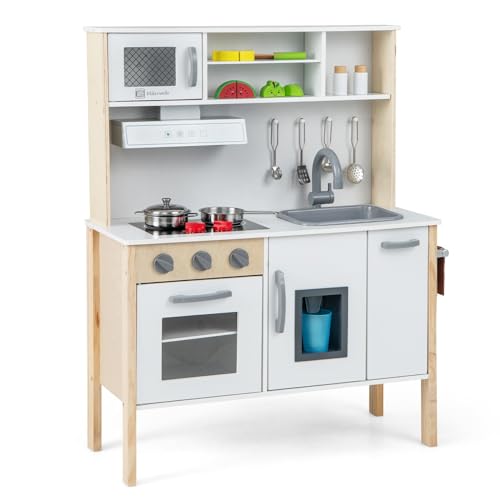
This white modern cabinet stacks in a microwave, a range hood, gas-style stoves with clicking knobs, a play sink with a rotatable faucet, an oven and an ice maker, plus 18 accessories that include a pot and pan, spoons and spatula, spice jars, a cup, ice cubes, a cloth and cuttable fruit with a wooden knife. There is ample storage behind the oven and in the cabinet, along with hooks and a towel rack, which doubles as a tidy-up lesson. At 72 by 30 by 90 cm it is a touch wider than our top pick, giving a child more bench to work along, and it ships with an anti-toppling device to fix it to the wall.
For the accessory count and the feature list, it is strong value at around $93. Owners describe a solid, sturdy kitchen once it is together and their toddlers getting heavy daily use out of it.
Flaws but not dealbreakers
Assembly is the loudest complaint, and it is a real one: several Australian owners report builds of two to six hours, with the tiny back hooks and door fittings singled out as fiddly. A drill helps enormously. A few reviews flag thin panels or a jam-prone ice maker, so it is not quite as refined as the dearer Teamson cabinets. With only 21 ratings it also has a thinner track record than our top picks. If you value the gear in the box over a long review history, it is a genuinely good buy.
Best for drawing and menus: Bopeep wooden play kitchen
For a child who loves to draw, write lists and play restaurant, the Bopeep pink wooden kitchen is the pick. It carries a 4.4-star rating and stands out for a chalkboard fridge door that turns pretend meal prep into a creative activity.
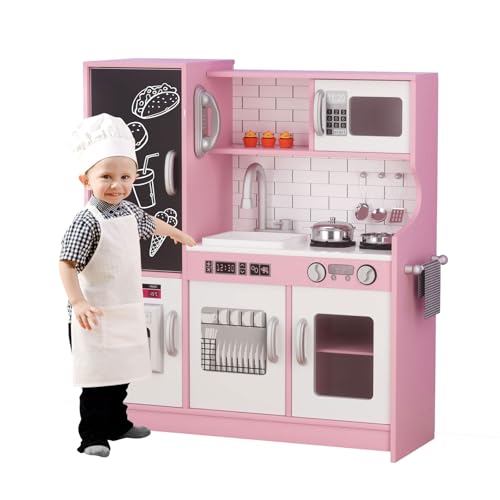
The Bopeep is a pink wooden cabinet with a sink and rotatable faucet, a stove, a microwave, an oven, an ice maker, a dishwasher and a towel rack, plus the chalkboard fridge front that kids use to scribble menus and grocery lists. It comes with a cup, a play phone, a towel, ice cubes, pans and spoons. At 75 by 24 by 80 cm it is one of the slimmer cabinets here from front to back, which helps it sit against a wall in a smaller room, and it includes anti-tipping hardware to secure it.
Owners describe a beautiful, photogenic kitchen that their children adore, and the chalkboard is the feature that gets called out most often as the thing that keeps play fresh. It is a lovely choice if aesthetics and creative play matter as much as cooking.
Flaws but not dealbreakers
It has the thinnest review history of the wooden cabinets in this guide, so the rating, while high, rests on fewer owners. Assembly draws the usual warnings about time and instructions that could be clearer, and a cordless drill is again recommended. A couple of buyers note it looks larger in photos than it is in person, so check the 80 cm height against your child. None of that undercuts a well-liked, characterful kitchen.
Best for the backyard: OLAKIDS outdoor mud kitchen
If the play you have in mind is sensory and messy rather than tidy indoor cooking, an outdoor mud kitchen is a different and brilliant category, and the OLAKIDS is our pick for it. It holds a 4.5-star rating and is built from solid fir wood designed to live outside.
The OLAKIDS is a fir-wood mud kitchen on two wheels with an easy-grip handle, so it rolls around the yard rather than staying put. It has a detachable water box with a working faucet for real water play, a stove with click sounds, a removable sink and open storage shelves for buckets, pots and garden finds. This is where kids mix water, soil, leaves and sand into glorious pretend meals, the kind of open-ended outdoor play that screen-weary parents tend to love. At 85 by 36 by 90 cm it is a generous outdoor size, and the weather-friendly timber and child-safe paint are made for the job.
Owners describe easy assembly relative to the indoor cabinets and a sturdy result that handles enthusiastic backyard use. If you have outdoor space, it complements an indoor kitchen rather than replacing it.
Flaws but not dealbreakers
It has a small number of reviews so far, so the rating rests on early owners. As an outdoor timber product it will weather over the seasons, and storing it under cover or sealing the wood will extend its life. It is also single-purpose: this is a muddy, watery outdoor toy, not a living-room centrepiece. For backyard sensory play, it is exactly right.
Biggest statement piece: Teamson Westchester retro kitchen
When you have the floor space and the budget for a show-stopper, the Teamson Westchester is the largest and most elaborate kitchen in this guide. It carries a 4.3-star rating from 426 owners and is built around a retro pink aesthetic with a separate fridge unit.
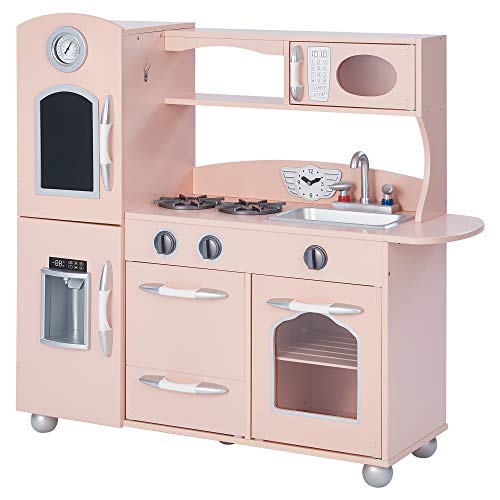
The Westchester is a multi-piece retro cabinet with a vintage pink and chrome look, a refrigerator with a pretend ice maker and a chalkboard panel, a microwave, a stove with clicking knobs, an oven and a removable stainless-look sink. It comes with a toy phone, a cup and pretend ice cubes. This is the big one: at around 21.9 kg and a footprint that spreads well beyond a metre once the fridge sits alongside the kitchen, it is a centrepiece, not a corner-filler. Available in several colours, it suits a dedicated playroom or a child who will use it for years.
Owners across several countries describe excellent quality, clear instructions and a kitchen that survives rough play, with the separate fridge and the worktop beside the sink called out as nice practical touches.
Flaws but not dealbreakers
It is the most expensive pick here at around $180, and the size cuts both ways: wonderful if you have the room, overwhelming if you do not, so measure your space before you commit. Assembly takes around two hours by most accounts. It earns its place as the premium splurge rather than the sensible default, which is why our top pick remains the more compact, more reviewed Florence for most families.
What should you look for in a kids play kitchen?
Match the kitchen to your space, your child's age and how long you want it to last. The same practical-life argument sits behind most Montessori toys. A few buying signals matter more than the marketing:
- Wood versus plastic. Wooden cabinets look better in a shared living space, feel sturdier and last across multiple children, but they cost more, weigh more and take real time to assemble. Plastic tabletop sets are cheaper, lighter and often add lights, sounds and water, at the cost of longevity.
- Footprint and height. Measure the corner before you buy. The compact cabinets here run around 55 to 75 cm wide, while statement pieces spread past a metre. Check the height suits your child too: most are built for ages three and up at roughly 80 to 95 cm tall. Do the same before you buy the other big pretend-play centrepiece, because the doll houses we rate run from apartment-friendly cottages to a mansion over a metre tall.
- Moving parts. Clicking knobs, turning faucets, opening oven doors and pull-out bins are what sustain pretend play. A static box gets boring fast, so prioritise interactivity over the number of printed-on dials.
- Accessories included. Counts range from a phone and a pan to 18 pieces. More in the box means less to buy later, though you can always add play food from a separate set. The kitchen also gets used far more once there is somewhere to sit and eat what has been cooked, which is what our kids table and chairs guide covers.
- Anti-tip hardware. Top-heavy kitchens can tip when a toddler leans or climbs. The better sets include a strap or device to fix the unit to the wall, which is worth using.
- Assembly reality. This is the most under-stated factor in the whole category. Budget an evening for a wooden cabinet and keep a cordless drill nearby. It is the single most common surprise in the reviews.
How do you care for and maintain a play kitchen?
A little upkeep keeps a play kitchen safe and presentable for years. Wipe wooden surfaces with a barely damp cloth rather than soaking them, since engineered wood and MDF swell if water sits on them. Tighten the screws and knobs every few months, because daily opening and closing works fittings loose over time, and a quick pass with a screwdriver prevents wobbly doors and lost handles.
If you bought a set with running water or steam, empty and dry the reservoir after each session and keep moisture well away from the battery compartment, which is the most common cause of electronic failure in the plastic sink units. For outdoor mud kitchens, store the unit under cover or sealing the timber will slow weathering, and let it dry out before packing toys back onto the shelves. Keep the anti-tip strap attached to the wall, check it occasionally, and store small accessories in the built-in bins so they do not become choking hazards for younger siblings.
What else will you want with a play kitchen?
The kitchen is the centrepiece, but a few add-ons make it far more fun and keep the play area safe and tidy. Every one of these kitchens generates loose plastic food, so sort the toy storage at the same time. These are the extras owners reach for most, all available on Amazon Australia:
What about IKEA, Plum, Kmart and the brands not on this list?
If you have been researching play kitchens, you have almost certainly seen the IKEA DUKTIG, Plum mud kitchens, Keezi and the Kmart and BIG W house brands recommended elsewhere. They are popular for good reason, but they do not sell through Amazon Australia, so they fall outside the scope of this guide. We only rank products we can verify as in stock with real Amazon ratings, which keeps our links honest and our prices current.
For the record, the IKEA DUKTIG remains the default budget wooden recommendation across most Australian roundups thanks to its adjustable leg height and low price, and you buy it directly from IKEA. Plum specialises in outdoor and mud kitchens sold through Plum Play and major retailers. Keezi, Costway and Somersault sets show up cheaply at Harvey Norman, Myer, Kmart and BIG W if you prefer to shop in person. None of that changes our pick: among the kitchens you can actually order on Amazon Australia today, the Teamson Florence is the strongest all-rounder.
Frequently asked questions about play kitchens
What age should you get a kid a play kitchen?
Most play kitchens are designed for ages three and up, which is the manufacturer rating on nearly every wooden cabinet in this guide, largely because of small accessory parts. That said, plenty of parents introduce a sturdy kitchen or a tabletop sink set from around 18 months to two years for supervised play, simply leaving out the smallest pieces. Pretend cooking interest typically peaks between two and five.
Is a five year old too old for a play kitchen?
No. Many children happily play with a kitchen up to around six or seven, and the play simply evolves from copying you to elaborate restaurant and cafe scenarios. Older kids tend to get more out of a larger cabinet with more features and accessories, so if you are buying for a four or five year old, lean toward a fuller set rather than a compact toddler unit.
Are wooden or plastic play kitchens better?
Wooden kitchens look better in a home, feel sturdier and last across multiple children, which is why they dominate our picks. Plastic sets are cheaper, lighter and often add lights, sounds and running water that wood cannot, but they wear out faster. If budget and durability matter most, choose wood. If you want affordability, portability or water play, a plastic tabletop set like our budget pick makes sense.
How long does it take to assemble a wooden play kitchen?
Plan for one to three hours for most wooden cabinets, based on what owners consistently report. The piece count is high and the fittings can be fiddly, so a cordless drill or electric screwdriver is repeatedly recommended to cut the time down. The instructions on the better-known brands are clear and numbered, so the job is tedious rather than confusing. Do not leave it for the night before a birthday.
Do play kitchens tip over?
Taller cabinets can tip if a toddler leans or climbs on them, which is why the better sets include an anti-toppling strap or device to fix the unit to the wall. Use it. If your chosen kitchen does not come with one, an inexpensive furniture anti-tip strap solves the problem and is worth fitting before play begins.
Which play kitchen has the most accessories?
Of our picks, the HONEY JOY wooden kitchen leads on accessories with 18 pieces in the box, including cookware, spice jars, cuttable fruit and a cloth. If a fully stocked kitchen out of the box matters more to you than a long review history, it is the one to look at, though you can always expand any kitchen with a separate play food set.
Are play kitchens worth it?
For most families yes, with one caveat. Pretend cooking carries language, fine motor skills and social play all at once, and a wooden cabinet survives three or four children, so the cost per year of use is low. The caveat is the window. Most children lose interest somewhere between four and six, so buying at two or three gets the most out of it, and buying for a five year old is a much shorter run.
When should you get rid of a play kitchen?
When it has not been played with for a few months and has quietly become a shelf, which for most children happens between five and six. A wooden cabinet resells well, so list it rather than tipping it. The other option is to move it outside and let it become a mud kitchen, which is exactly what the OLAKIDS pick is built to be, and that usually buys another year or two of use out of it.
How do you make a play kitchen functional?
Two upgrades do most of the work. Add real water: the CUTE STONE Play Sink already has a working tap and reservoir, and any cabinet takes a small jug and a washing-up tub. Then swap in real utensils, a wooden spoon, a small whisk and a metal bowl, because children copy what they see rather than what is printed on the panel. Cut fruit at snack time turns it into somewhere they actually use.
Complete the nursery and playroom
A play kitchen is one piece of the puzzle. If you are setting up or refreshing a nursery and play space, these NestPath guides pair naturally with it and are built on the same in-stock, real-rating approach:
About the author
Anish Puri founded NestPath in 2026 after going through the Australian first-home-buyer process himself. NestPath focuses on Australian first-home buyers because the existing review sites are American, generic, or both. Anish handles editorial selection across the homeowner hub. Reach out: hello@nestpath.com.au