If you work from home (even two or three days a week), your office chair is arguably the most important piece of furniture you own. You spend more time in it than you do in your bed (assuming you sleep 8 hours and work 8 hours, you're in your chair for the same duration every working day). The difference between a poor chair and a good ergonomic chair isn't comfort; it's whether you end your working day with back pain or without it.
Working from home is now routine for many Australians, and there are genuine ergonomic options at every price point. Understanding what you are actually paying for at each tier makes the decision much clearer.
This guide covers the key ergonomic adjustments, the mesh vs leather vs fabric decision, and the specific chairs worth buying in 2026, from budget mesh chairs to premium chairs from Steelcase and Herman Miller.
Why a Good Office Chair Matters
Sitting is biomechanically complex. A well-designed chair supports your natural spinal curves (lumbar, thoracic, and cervical), keeps your hips at or slightly above knee height, positions your arms at desk height without shoulder elevation, and allows natural movement throughout the day.
A poor chair forces your spine into positions it can't sustain, typically a forward head posture (chin jutting forward, upper back rounding), lumbar flexion (lower back flattening or reversing its natural inward curve), and hip flexor tightening from hours in the same static position. The result: lower back pain, neck tension, shoulder tightness, and hip flexor problems that compound over months and years of desk work.
The Five Adjustments That Matter
A truly ergonomic chair provides five key adjustments. Not all chairs at all price points offer all five, and knowing which ones you actually need helps you choose correctly.
Seat height adjustment: essential. It allows you to position your thighs parallel to the floor with feet flat. Available on all desk chairs. Seat depth adjustment: important for taller and shorter users. It allows you to set how far forward the seat extends relative to the chair back. Lumbar support: critical. It supports the natural inward curve of the lower back. Available as fixed, adjustable height, or self-adaptive in better chairs. Armrest adjustment (height, width, angle): important for shoulder health. Poorly positioned armrests cause the shoulders to elevate or internally rotate. Tilt tension and lock: allows the chair to recline with appropriate resistance, reducing static loading on the spine.
Mesh vs Leather vs Fabric
The upholstery material affects comfort, durability, and suitability for Australian conditions in different ways.
Mesh
Mesh back (and sometimes seat) chairs are the dominant choice for ergonomic office seating for good reason. The breathable mesh allows airflow across your back, which matters in Australian conditions: a leather or fabric chair in a warm home office in summer can leave you with a sweaty back.
Quality mesh (Herman Miller's 8Z Pellicle, HM's original Pellicle, Humanscale's mesh) is engineered to provide even support across the back surface without pressure points, while cheaper mesh in sub-$200 chairs can sag and deform within 1-2 years, losing its supportive properties. When buying a mesh chair, sit in it for at least 15-20 minutes if possible. Cheap mesh feels immediately firm but becomes uncomfortable as it flexes under sustained body weight.
Leather and Vinyl
Leather and faux leather (PU vinyl) chairs look professional, are easy to wipe clean, and handle spills without absorbing them. The disadvantages: poor breathability (hot in Australian summers, cold in winter), and they lose their appeal quickly as the coating cracks and peels on budget options (genuine leather is more durable but costs $800+). For Australian home offices without air conditioning, leather chairs are a poor choice for summer comfort.
Fabric
Fabric chairs offer better breathability than leather (though not as good as mesh), are typically more durable than budget vinyl, and come in a wider range of colours and textures. They're harder to clean for spills (coffee stains are a genuine concern at a desk) but otherwise a practical mid-ground between mesh and leather. Used in many mid-range chairs including some ErgoTune models.
Best Budget Office Chairs ($200 to $400)
The $200-$400 range is where genuinely functional ergonomic chairs begin. Below $200, chairs generally don't provide adequate lumbar support, armrests are either absent or non-adjustable, and build quality degrades quickly: the hydraulic gas lift fails, the armrests crack, the foam cushion compresses permanently.
FLEXISPOT OC3: Ergonomic Value Pick
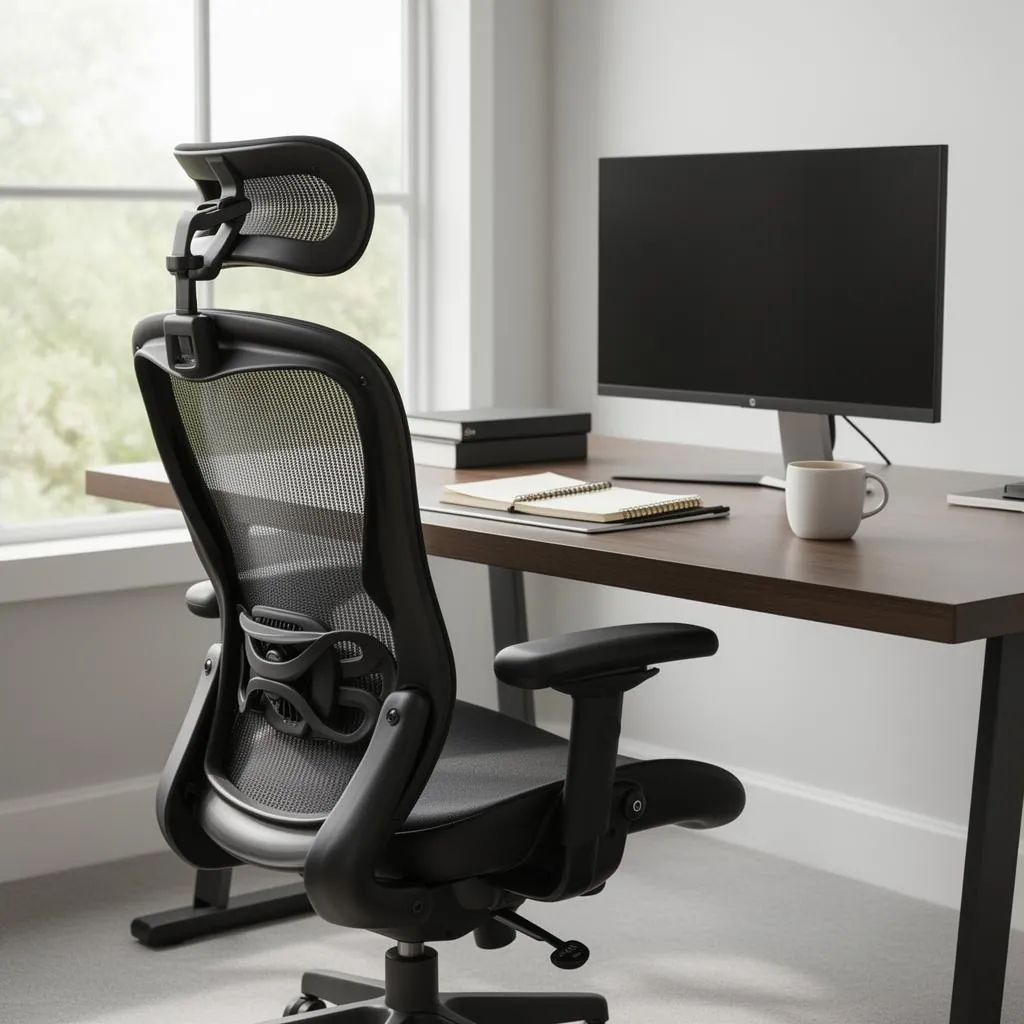
The FLEXISPOT OC3 is our budget pick. It has a mesh back and seat for airflow in warm weather, adjustable lumbar support and backrest, a headrest, 3D armrests, and adjustable seat height and depth. A lockable recline with 90, 110 and 130 degree positions and adjustable tilt tension lets you set how it leans.
It is rated for users up to 100kg, so check that rating against your own weight. It is sold on Amazon AU by SanoDesk.
The IKEA Markus is another option at this tier, sold through IKEA rather than Amazon AU. If you can visit an IKEA showroom, it is worth comparing; check IKEA for its current price and warranty.

Best Mid Range Office Chairs
The mid range is where you find serious ergonomic chairs designed for extended daily use. Australian brand ErgoTune designs its chairs for the work from home market.
ErgoTune Classic: Designed for Australian WFH
The ErgoTune Classic was designed specifically for the Australian market. Its adjustments include seat height and depth, armrest height and angle, lumbar height and depth, headrest height and angle, and tilt tension, so you can set the chair to your body rather than accept a compromise.
The self-adaptive lumbar support is the standout feature: a spring-loaded lumbar pad that moves with you as you shift position throughout the day, maintaining contact and support rather than staying fixed as your posture changes. For people who move frequently (which is healthy), this is more effective than a fixed lumbar pad you set and forget.
Buying a chair online means you cannot test it first, so check ErgoTune's current trial and warranty terms for the exact model before you buy.
Best Premium Office Chairs ($800+)
Above $800, you are looking at chairs built for long daily use, with commercial grade construction and long warranties. Steelcase and Herman Miller are the two names you will meet most often here.
Steelcase Gesture: Our Top Pick
The Steelcase Gesture is our top pick. Its 3D LiveBack is designed to flex with your spine as you change posture, and its arms rotate a full 360 degrees to support your movements. Lumbar support and seat depth both adjust, a 4 way tilt stop and tension control set the recline, and soft edges around the seat let you sit in other positions without pressure on the back of your legs.
It carries a 12 year manufacturer's warranty and is sold on Amazon AU by Steelcase Australia. Two caveats: the seat and back are upholstered in fabric rather than mesh, so it runs warmer than a mesh chair in an Australian summer, and stock on Amazon AU is limited, so check availability before you plan around it. It comes with carpet casters, so hard floors may need a different set.
The Herman Miller Aeron remains a benchmark premium mesh chair. In Australia it is sold through Living Edge, Herman Miller's authorised distributor. Check Living Edge for current pricing, sizes and warranty terms.
Key Features That Actually Matter
Office chair marketing is full of features that sound impressive but deliver limited real-world benefit. These are the ones that genuinely affect your health and comfort at a desk.
Lumbar Support: The Most Important Feature
The lumbar (lower back) support maintains your spine's natural inward curve when seated. Without adequate lumbar support, the lower back flattens or reverses its curve over hours of sitting, loading the intervertebral discs in a position they're not designed to sustain.
Adjustable lumbar height is important because lumbar height varies significantly between individuals: a fixed lumbar pad at the wrong height provides no benefit. Self-adaptive lumbar (ErgoTune, some premium chairs) moves with your natural position changes throughout the day.
Seat Depth Adjustment
Often overlooked, seat depth determines how much support the chair provides your thighs. The correct seat depth leaves 2-3 fingers of clearance between the front of the seat and the back of your knees: too deep and the seat edge presses on your thigh circulation, too shallow and you're not using the back of the chair. Fixed seat depths don't accommodate the range of human leg lengths effectively.
Armrests
Poorly adjusted armrests cause shoulder elevation (too high) or shoulder abduction (too wide), both of which cause upper trapezius tension and neck pain over time. Height-adjustable armrests are the minimum. Width and angle adjustment matters for users who work with their arms close to the body (keyboard-heavy work) versus wider shoulder positions.
Breathability in Australian Conditions
Australia's warm climate makes chair breathability more important than in European or American contexts where most ergonomic chair design traditions developed. Mesh back chairs are significantly more comfortable through Australian summers and reduce the fatigue associated with overheating. For anyone without air conditioning or in a warm home office, mesh is the safer choice.
Frequently Asked Questions
Can an office chair actually prevent back pain?
A properly fitted ergonomic chair can significantly reduce, though not eliminate, the musculoskeletal strain of prolonged sitting. The research is clear that a chair with adequate lumbar support, correct seat height, and appropriate armrest positioning reduces activation of the muscles that work to maintain posture against an unsupportive chair, reducing fatigue and the cumulative strain that leads to pain. However, no chair eliminates the need to take regular movement breaks, sitting for more than 45-60 minutes continuously, regardless of chair quality, loads the spine in ways that movement resolves. The best ergonomic chair combined with no movement breaks is less healthy than a basic chair combined with standing up every 45 minutes. If you have a sit-stand desk, an under-desk walking pad turns the standing blocks into slow walking.
How long should an office chair last?
A quality office chair at the $400+ price point should last 8 to 12 years with normal home use. The components most likely to wear first: the gas lift (a wobbly or sinking chair usually means the gas lift needs replacing, and it is a replaceable part), the foam cushion (compression over 3 to 5 years in budget chairs, longer in quality chairs), and the armrest upholstery (cracks and peels on vinyl, typically within 3 to 5 years). Mesh backs last longer than foam or vinyl surfaces. Premium chairs such as the Steelcase Gesture carry a 12 year manufacturer's warranty.
What height should my office chair be set at?
The correct seat height positions your thighs parallel to the floor (or very slightly angled downward) with your feet flat on the floor. At this height, your knees form approximately a 90-degree angle and your hips are at or slightly above knee level. At your desk, your forearms should rest on the desk or armrests with your shoulders relaxed and elbows at approximately 90 degrees: if you need to raise your shoulders to reach the keyboard, your chair is too low. If you need to stoop over the keyboard, your chair is too high. If your feet don't comfortably reach the floor at the correct chair height for your desk, use a footrest rather than lowering the chair to compensate. A lowered chair positions the hips below knee height, which increases lumbar flexion.